How many hops a MANET mesh can support is rarely the same as how many it should use in operation. A route may remain connected across numerous relays while video quality drops, command latency rises, or shared airtime becomes a bottleneck. Different traffic types can also reach their limits at different points, so a single advertised hop count cannot answer the planning question.
The key is to judge MANET mesh hops by usable throughput, end-to-end delay, jitter, mobility, and RF conditions. The discussion below explains how those trade-offs develop and how to set a practical hop budget for real deployments.
The Useful Hop Count Is Set by the Application
Start With the Required Service Level
No fixed limit for MANET mesh hops applies to every deployment because applications fail in different ways. A route may remain connected while goodput has fallen below a video encoder’s output rate, voice jitter has become noticeable, or command latency has exceeded an operational threshold. Before setting a limit for MANET mesh hops, define minimum end-to-end goodput, maximum one-way or round-trip delay, acceptable jitter, and the target packet delivery ratio.
Measure these thresholds at the application boundary, not from the radio’s PHY rate. Headers, contention, retries, and relay traffic reduce useful payload capacity. The practical limit for MANET mesh hops is the first point where the service level fails under expected load, even if endpoints still exchange packets.
Different Traffic Types Reach the Limit at Different Times
Telemetry uses little bandwidth, but stale data may still be unacceptable. Command traffic needs predictable response, voice depends on controlled delay and jitter, and live video needs sustained goodput. Video therefore exposes weak MANET mesh hops earlier than intermittent data.
Traffic class
Primary constraint
Useful acceptance measure
Telemetry
Delivery reliability
Packet delivery ratio and data age
Command and control
Predictable response
One-way and p95 latency
Voice
Delay variation
Jitter, loss, and sustained latency
Live video
Continuous capacity
End-to-end goodput and frame stability
A path that carries telemetry successfully may fail when several HD streams are introduced. Claims such as “five hops is safe” have little value unless traffic mix, packet sizes, RF conditions, and acceptance thresholds are also specified.
How Delay Builds Along a Multi-Hop Route
Each Relay Adds More Than Processing Time
Every relay adds several forms of delay. A packet must cross the current link, wait for channel access, pass through forwarding logic, and enter the next transmission queue. Damaged frames may be sent again, so poor link quality increases delay as well as airtime use. A practical model is: end-to-end delay equals accumulated per-hop delay plus queueing, retransmissions, and route-change penalties.
Multiplying a laboratory single-hop figure by the number of MANET mesh hops gives only a baseline. It assumes stable links and little competing traffic. In the field, one overloaded relay or weak RF segment can add more delay than several clean hops.
Congestion Makes Latency Grow Unevenly
At low utilization, another relay may add fairly consistent delay. Once traffic approaches the capacity of a shared node, queues build, and a small increase in offered load can produce a much larger increase in end-to-end latency. Forwarding conflicts, MAC behavior, routing policy, and node distribution all influence achievable throughput, while sending beyond a path’s useful rate can increase contention and reduce delivered performance.
An acceptable average can hide operationally significant spikes. Report median, p95 or p99 latency, jitter, and loss to show whether MANET mesh hops remain predictable under converging flows.
Moving Nodes Add Route-Recovery Delays
Mobility creates temporary spikes when links break and routes change. Nodes may update neighbor state, buffer packets, invalidate a path, discover an alternative, and resume forwarding. AODV obtains routes for active destinations and responds to link breakages and topology changes in dynamic multi-hop networks.
OLSR takes a proactive approach, exchanging topology information regularly and keeping routes available. Multipoint relays reduce redundant control-message forwarding. This can avoid first-packet discovery, but periodic updates still consume capacity, and faster updates add overhead. The practical issue is how routing behavior affects delay under the actual density, mobility, and traffic pattern.
Why Throughput Shrinks as Hops Are Added
Forwarding the Same Traffic Reuses Network Capacity
A relay does not create fresh spectrum. It receives traffic and retransmits it, using airtime that could otherwise carry a new packet. In a shared-channel, half-duplex route, nearby forwarding nodes may need to take turns, while hidden-node collisions trigger backoff and retries. As MANET mesh hops increase, the same application payload consumes radio resources repeatedly.
The weakest or busiest link can determine end-to-end goodput. A lower-rate segment occupies the medium longer, while a central relay may saturate despite lightly loaded surrounding links. PHY rate is not usable destination throughput. Excess offered load creates queues and loss rather than more goodput.
Concurrent streams intensify the problem. Relay traffic contributes to interference, and capacity declines as more communication streams share the same forwarding resources. A one-stream demonstration should not be treated as proof that the same MANET mesh hops can support several video, voice, and telemetry flows at once.
Avoid the “Bandwidth Halves at Every Hop” Shortcut
The claim that every wireless hop automatically cuts bandwidth by 50 percent is too simple. Severe degradation can occur in a single-radio, same-channel chain, but no universal percentage applies to every MANET. Performance changes with channel reuse, scheduling, MIMO operation, channel width, link quality, traffic direction, and the number of active flows.
A planned route can preserve capacity by reducing interference and avoiding weak links. Multi-channel operation and scheduling may separate conflicting forwarding activity. Link-aware routing may also prefer a slightly longer path with stronger, less congested links because delivery ratio, interference, and shared capacity matter alongside hop count.
An illustrative chart could compare normalized goodput across one to eight MANET mesh hops for a congested linear chain and a route with stronger links and better resource reuse. It should be labeled as a planning illustration, not a benchmark. The loss per additional MANET mesh hop must come from tests using the intended configuration and traffic load.
The Conditions That Move the Hop Ceiling
Topology Matters More Than Total Node Count
Node count alone says little about path performance. A 30-node network in which most active routes are one or two hops long may be more consistent than a 10-node network arranged as one long chain. Linear paths repeatedly reuse the same forwarding corridor, whereas a partial mesh can offer shorter or less congested alternatives.
The busiest locations matter more than the theoretical network diameter. Central relays, gateway-adjacent nodes, or airborne units serving several downstream nodes can become concentration points for payload and control traffic. A resilient design keeps primary flows on short, high-quality routes while preserving extra MANET mesh hops for coverage and recovery.
RF Quality Can Make an Extra Hop Helpful
The route with the fewest relays is not always the fastest. One long link may suffer from low SNR, reduced modulation, packet loss, and repeated retransmissions. Dividing it into two shorter, stronger links adds a forwarding step, but higher link rates and fewer retries may improve both goodput and tail latency.
The outcome depends on antenna placement, obstruction, interference, transmit power, receiver sensitivity, and channel bandwidth. A well-positioned line-of-sight relay can improve the route; a poorly placed one merely adds contention. Route selection should therefore evaluate link quality and available capacity rather than minimizing MANET mesh hops at any cost.
Read Product Hop Claims in Their Test Context
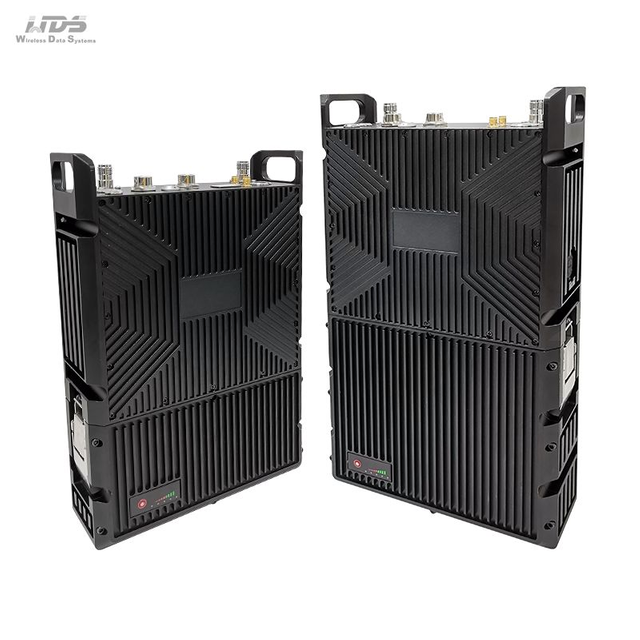
Configuration-dependent performance figures can provide a useful starting point. For low-latency MANET mesh hops, the WDS MIMOmesh Lightweight Airborne Series averages 6 ms of one-way delay per hop at 20 MHz and supports 15+ data hops, 10+ voice hops, and 8+ video hops. Available technical capabilities include configurable channel bandwidth, adaptive rates and modulation, QoS, and several MIMO techniques.
These figures illustrate why MANET mesh hops may be rated separately by traffic type. They should still be checked against payload rate, spacing, interference, mobility, packet size, and concurrent load. Eight hops multiplied by a 6 ms baseline suggests 48 ms one-way before queueing, retries, or route recovery. The useful number of MANET mesh hops must therefore be confirmed at the application layer rather than copied directly from a specification.
Set a Defensible Hop Budget Before Deployment
Test the Network With Real Traffic, Not an Empty Link
Field testing should reproduce the expected traffic mix. Define video bitrates, voice sessions, telemetry volume, control frequency, packet sizes, and direction. Then test at one, two, four, six, and eight MANET mesh hops, adding intermediate points as results approach the acceptance threshold.
Keep channel settings and offered load consistent. Repeat with representative obstruction, interference, movement, and a relay-loss event. Measure delivered performance, not headline radio rate.
Separate the Normal Limit From the Failover Limit
Set pass-or-fail thresholds before reviewing results. The normal operating limit should support the full traffic mix with margin for added users, RF variation, and route movement. A separate degraded-mode limit can permit more MANET mesh hops when the objective is to preserve essential command or telemetry after a relay failure.
This distinction prevents an emergency path from being mistaken for a routine high-capacity route. A longer path may remain valuable even when it cannot carry normal voice or video. Define the SLA, test realistic load, identify the first failed threshold, reserve margin, and set the operational budget below that point. Separate limits for each traffic class are more useful than one network-wide maximum.
Conclusion
The practical limit for MANET mesh hops is not the longest route a network can form, but the longest route that still meets its latency, throughput, jitter, and reliability targets. Testing realistic traffic and RF conditions helps teams set separate hop budgets for video, voice, control, and telemetry while preserving longer paths for failover.
Shenzhen Sinosun Technology Co., Ltd. provides MIMOmesh radios designed for dynamic multi-hop communication, giving network planners configurable tools to balance coverage, mobility, and data performance. Used with application-level testing, these systems can support more dependable deployment decisions.
FAQ
Q: How many MANET mesh hops can a network support?
A: No universal limit applies. The practical maximum is the longest route that still meets required latency, throughput, jitter, packet-delivery, and mobility targets under realistic traffic conditions.
Q: How does each additional hop affect latency?
A: Each relay adds transmission, channel-access, processing, queueing, and possible retransmission delay. Under congestion or route changes, latency may rise sharply rather than increasing by a fixed amount.
Q: Does mesh throughput halve with every hop?
A: No. A 50 percent drop is only a rough rule for certain shared-channel, half-duplex chains. Actual loss depends on channel reuse, interference, scheduling, MIMO, and traffic load.
Q: Is the route with the fewest hops always better?
A: Not always. One weak long-distance link may perform worse than two shorter, stronger links. Route quality should consider SNR, retransmissions, congestion, and available capacity alongside hop count.
Q: How should engineers set a practical hop limit?
A: Test representative video, voice, control, and telemetry loads across increasing hop counts. Set the operational limit below the first point where any application-level service threshold fails.