Once MAVLink traffic leaves a direct radio link and starts crossing a mobile ad-hoc network, the hardest problems are rarely raw range alone. Shared airtime, changing relay paths, delayed acknowledgements, and misleading packet-loss readings can affect command reliability long before the connection appears to fail. MANET routing is built for changing topology, while MAVLink adds its own addressing, sequencing, and command-delivery behavior.
Understanding how those layers interact helps engineers size bandwidth, interpret loss correctly, control routing, and define fail-safe actions that remain predictable when links degrade or disappear.
Start With the Traffic the Mission Must Carry
Separate essential MAVLink traffic from optional data
Not every byte has equal operational value. Heartbeats, commands, acknowledgements, emergency actions, position, battery state, and navigation health directly affect supervision and control. Mission uploads, parameter transfers, logs, maps, imagery, voice, and video may still matter, but most can tolerate delay or suspension when the network is stressed. MAVLink reflects this difference: telemetry is commonly published as a stream, while missions, parameters, and commands use point-to-point microservices with acknowledgement or retransmission behavior.
The first design task is to define which messages must survive a degraded link. A vehicle that keeps sending high-rate attitude data while command acknowledgements wait in a queue has been prioritized incorrectly. A sound MAVLink over MANET policy preserves command state, heartbeat freshness, position, power, navigation quality, and fault reporting before richer situational data.
Traffic class
Typical content
Network treatment
Congestion response
Control-critical
Commands, acknowledgements, emergency actions
Highest priority
Preserve
Essential awareness
Heartbeat, position, battery, system health
High priority
Reduce cautiously
Mission services
Parameters, waypoints, logs
Medium priority
Pause and resume
Payload traffic
Video, imagery, voice, bulk files
Lowest priority
Throttle or suspend
Calculate usable capacity at the busiest relay
Bandwidth should be calculated from the application outward, not from the radio specification inward. Add message size, update frequency, vehicle count, MAVLink framing, IP/UDP headers, routing traffic, retransmissions, and expected bursts. Then examine the relay carrying the greatest aggregate load, because a central node may forward several vehicles even when each individual link appears lightly used. The useful figure is sustained end-to-end capacity under movement and interference, not peak physical-layer rate.
Every wireless hop consumes airtime again. Route discovery, recovery, and temporary detours add further overhead, so capacity planning needs margin for weak links and new nodes joining. Operating near the theoretical maximum turns a small topology change into queue growth, jitter, and delayed commands.
Protect control traffic before throttling telemetry
Quality of service should be active before congestion starts. Put commands, acknowledgements, heartbeats, and critical health messages in the most delay-sensitive class, normal telemetry below them, and payload streams last. When queues rise, stop file transfers and logs first, reduce nonessential telemetry next, and constrain video last. MAVLink over MANET remains useful only when the network can sacrifice detail without sacrificing control.
Read Packet Loss in the Context of the Network
Know when MAVLink sequence gaps become misleading
MAVLink packets contain an 8-bit sequence number that increments on each channel and wraps after 255. A receiver can compare consecutive values and treat missing numbers as lost packets, which is meaningful when it receives the complete output of one channel. That assumption usually holds for a simple point-to-point telemetry link.
A routed mesh can break the assumption without dropping data. A router may send camera messages to one endpoint and flight data to another, so the ground station sees sequence gaps even though the router received every frame. Redundant links use independent counters, while route changes can reorder or duplicate packets. An apparent loss rate may therefore describe what one application did not see, not what the MANET failed to deliver.
Combine loss figures with operational health metrics
Sequence gaps should be paired with heartbeat age, round-trip delay, jitter, command acknowledgement time, duplicates, out-of-order arrivals, router queue drops, hop count, and route-change frequency. Track these measures by source system, component, path, and traffic class rather than combining the fleet into one percentage. A long average may look healthy while a brief delay burst has already pushed a control transaction beyond its deadline.
Correlated measurements make faults easier to separate. Falling signal quality with receive errors points toward the RF path; growing queues with stable radio statistics suggests congestion; frequent path changes with reordered packets indicates route churn. If only one endpoint reports loss while others remain current, forwarding policy may be responsible. The useful question is which information missed which operational deadline, and where.
Draw a Clear Boundary Between MAVLink and MANET Routing
Let the MANET choose paths and MAVLink choose recipients
Two routing layers are involved. The MANET discovers neighbors, selects IP paths, forwards packets through relays, and repairs broken connectivity. MAVLink identifies logical systems and components, allowing broadcast delivery or targeting through target_system and target_component. Every system needs a unique system ID, while component IDs must be unique within it.
IP reachability does not guarantee correct command delivery. Two reachable vehicles can share a MAVLink system ID, and a router can create an application-layer loop even when the MANET path is valid. Forwarded packets should retain their original content, while addressed traffic should follow learned recipient locations rather than being flooded.
Limit broadcasts and handle redundant paths deliberately
Broadcast telemetry supports discovery and shared awareness, but uncontrolled replication becomes expensive as vehicle and relay counts grow. Heartbeats and required discovery messages should reach relevant endpoints; high-rate streams should be filtered or targeted once recipients are known. Routers must not return a frame through its incoming interface, and stale routing knowledge should be cleared after a remote reboot.
Redundancy also needs an explicit policy. MAVLink has no general mechanism for reconciling identical data arriving through multiple channels, and channel sequence counters cannot reliably identify cross-path duplicates. A design can use a primary path with failover or de-duplicate traffic at a controlled aggregation point. High-latency paths still require command expiry and selection rules.
Map the design onto airborne and ground equipment
A typical data path separates flight-control messaging from the underlying mesh transport:
Flight Controller → MAVLink Router → Airborne MANET Radio ⇄ Relay Nodes ⇄ Ground Radio → GCS
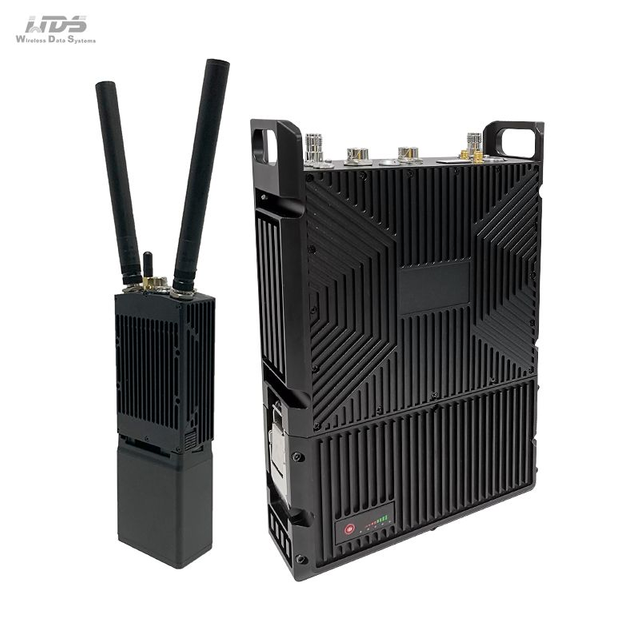
Aircraft-side selection is constrained by weight, power, heat, interfaces, frequency bands, and routing behavior. The lightweight WDS MIMOmesh airborne series supports configurable channels, dynamic Layer 2 or Layer 3 routing, multi-hop relay, adaptive QoS, transparent Ethernet and serial transport, and MAVLink integration. A nominal average one-way single-hop delay of approximately 6 ms at 20 MHz must still be verified with the selected airframe, antennas, topology, and traffic mix.
At the control site, a WDS DDLmesh vehicular or rack-mounted node can aggregate flight-control data with video, voice, or other payload streams. Its capabilities include adaptive QoS, dynamic multi-hop routing, serial and Ethernet transparent transport, selectable service priority, and MAVLink support. Ground equipment should be sized for the busiest relay load and provide operators with visibility into topology, link quality, traffic levels, and route changes.
Make Link Failure a Controlled State Transition
Detect degradation before the connection disappears
A binary “connected” flag reacts too late and often oscillates. A better controller separates the link into Healthy, Degraded, Critical, Lost, and Recovered states. Healthy means current heartbeats, stable routes, and acceptable command delay; Degraded begins as jitter, queues, route changes, or delivery problems rise; Critical indicates missed control deadlines. Lost starts after a defined heartbeat timeout, while Recovered requires sustained stability.
Use moving windows, consecutive violations, and hysteresis for state changes. One late heartbeat should not trigger Return, but repeated delayed acknowledgements must not be hidden by a good average. In Degraded operation, lower selected telemetry rates, pause transfers, and suspend payload video. Flight-control systems can separate data-link timeouts from responses such as Hold, Return, or Land.
Make commands safe under delay, duplication, and retries
Critical commands are transactions, not fire-and-forget datagrams. MAVLink expects a matching COMMAND_ACK reporting whether a command was accepted, rejected, failed, or remains in progress. If no acknowledgement arrives, the sender may retransmit the command. That improves delivery but creates duplicate risk when the original command executed and only its acknowledgement was lost.
Bound retries so a failing path cannot fill its queues. Sensitive commands also need an application-level expiry condition, preventing an old mode change from executing after the mission phase changes. Idempotent handling makes repeats safe, while unstable links should pause mission uploads and parameter writes. Resume only after checking the remote transaction state, and discard stale operations.
Choose the lost-link action from mission risk
No single lost-link response fits every mission. Continuing may suit open terrain with valid navigation and adequate energy, while Hold can cover a brief relay outage. Return is appropriate only when route, altitude, and battery state make it safer than staying. Land may be preferable near a designated recovery site or when continued flight creates greater risk.
The decision should include vehicle type, flight phase, terrain, airspace, navigation quality, energy reserve, payload hazards, and backup links. Recovery must also be explicit. Some systems remain in fail-safe mode after MAVLink heartbeats resume, requiring an operator mode change rather than silently restoring the previous state.
After reconnection, clear obsolete commands, refresh routes, confirm vehicle and mission state, and verify current health data. Automatic restoration may suit a low-risk interruption; manual confirmation is safer once Return or Land has begun. Hysteresis should prevent rapid switching when the recovered route remains marginal.
Prove the behavior with failure-focused testing
Peak-throughput and range demonstrations do not prove control resilience. Test normal telemetry with payload traffic, moving relays, weak signals, node removal, route switching, path failure, radio restart, and network rejoin. Record RF statistics, routing events, MAVLink timestamps, acknowledgements, and aircraft modes on one synchronized timeline.
Failure scenario
Expected network behavior
Expected aircraft behavior
Pass criterion
Payload congestion
Prioritize control and throttle payload traffic
Remain in the commanded mode
Heartbeats and acknowledgements stay within limits
Relay disappears
Select an alternate route
Continue or enter the Degraded state
Recovery occurs before the lost-link timeout
All paths fail
Stop stale forwarding
Execute the configured fail-safe
The correct action begins on schedule
Link returns
Rebuild the route and discard expired traffic
Follow the recovery policy
No stale commands or rapid mode cycling
Acceptance criteria should cover heartbeat gaps, command completion, route recovery, duplicate tolerance, correct fail-safe action, and stable recovery. Repeat the matrix across realistic ranges, vehicle counts, hop counts, and traffic loads. The configuration must pass with mobility and interference, not only in an unloaded laboratory. That evidence shows whether MAVLink over MANET will degrade predictably rather than fail catastrophically.
Conclusion
Reliable MAVLink over MANET performance depends on more than available throughput. Control traffic must receive priority, packet-loss figures must be interpreted in routing context, and fail-safe states must remain predictable as paths change or disappear. A well-designed network also separates MANET path selection from MAVLink system and component addressing.
Shenzhen Sinosun Technology Co., Ltd. offers lightweight MIMOmesh airborne radios and DDLmesh ground-side equipment that support multi-hop routing, adaptive QoS, and transparent MAVLink transport. These capabilities can help integrators preserve command traffic, manage mixed data loads, and build more resilient air-to-ground communication architectures.
FAQ
Q: Can MAVLink operate over a MANET?
A: Yes. MAVLink can run over IP-based MANET links, allowing vehicles, relay nodes, and ground stations to exchange telemetry and commands across changing network paths.
Q: How much bandwidth does MAVLink over MANET require?
A: Bandwidth depends on message rates, vehicle count, routing overhead, and payload traffic. Critical commands and telemetry should receive priority over video, logs, and file transfers.
Q: How is MAVLink packet loss measured on a mesh network?
A: MAVLink uses packet sequence numbers, but routing, redundant links, and selective forwarding can create misleading gaps. Loss should be evaluated alongside latency, jitter, and heartbeat age.
Q: Does MAVLink or the MANET control message routing?
A: The MANET selects network paths between nodes, while MAVLink uses system and component IDs to direct messages toward the correct vehicle, ground station, or onboard component.
Q: What happens when a MAVLink connection is lost?
A: The configured autopilot response may include holding position, returning, landing, or continuing the mission. Heartbeat timeouts commonly determine when the data-link fail-safe activates.
Q: How can critical commands remain reliable during packet loss?
A: Critical commands should use acknowledgements, bounded retries, expiration rules, and traffic prioritization. This prevents delayed or duplicated instructions from creating unsafe behavior after route recovery.