A wireless video link can look flawless during a stationary line-of-sight test, then freeze as soon as a vehicle turns behind a building or a drone drops below terrain. The difference is not simply range: multipath, NLOS obstruction, and motion can introduce delayed signal copies, deep fades, and Doppler effects that challenge OFDM reception.
The COFDM vs OFDM decision therefore depends on how each complete radio profile handles coding, guard intervals, channel changes, usable bitrate, and recovery. Understanding those factors helps you choose a link that stays usable on the actual route, not only in ideal test conditions.
The Fast Answer: Mobility Changes Which Strengths Matter Most
On an Open Path, Both Approaches Can Deliver Good Video
With clear Fresnel clearance, strong signal margin, and little movement, both approaches can carry stable HD video. A stationary test mainly proves that the radios have adequate received power under favorable geometry. It says little about their response during motion. Peak bitrate and maximum LOS range therefore reveal only part of the COFDM vs OFDM result. Mobile users also need to know whether the picture survives a fade and how quickly it returns.
Three Conditions Push the Decision Toward a More Robust Profile
A conservative profile becomes more valuable when the receiver sees many reflected paths, loses the dominant direct path, or moves faster than channel tracking can follow. These conditions create burst errors, unstable estimates, and deep frequency-selective fades. The viewer experiences macroblocking, frozen frames, resolution changes, or decoder resets. A COFDM-oriented setup usually trades payload for continuity through stronger coding, lower-order modulation, or added protection time. The result may contain less peak detail, but a steady lower bitrate is often more useful than a high-rate feed that repeatedly collapses.
“COFDM vs OFDM” Is Really a System-Level Comparison
The practical comparison is between complete radio profiles, not two acronyms. Coding rate, interleaving, guard interval, channel estimation, antenna diversity, RF design, and video buffering all shape the displayed picture. A well-engineered OFDM radio can outperform a poorly configured COFDM link, especially when the latter is pushed beyond its fade margin. The real question is which system stays usable under the failures the route will create. That framing keeps COFDM vs OFDM tied to the mission rather than marketing shorthand.
Why Multipath and NLOS Disrupt Mobile Video So Quickly
Reflections Create Delayed Copies of the Same Signal
In an urban street, factory, port, or mountain pass, the receiver rarely gets one clean path. Buildings, vehicles, metal surfaces, water, and terrain reflect energy along routes of different lengths. Those copies arrive at different delays and amplitudes, strengthening some frequencies while cancelling others. The resulting delay spread is often the reason a stationary picture changes abruptly after only a small movement.
One consequence is frequency-selective fading, where some subcarriers remain strong while others fall into deep nulls. Another is inter-symbol interference, which occurs when a delayed copy extends into the following symbol. OFDM reduces the difficulty by dividing a wide channel into many narrow subchannels, but the receiver still needs suitable protection and channel estimates. Average power can look acceptable while critical carriers are damaged.
This behavior explains why COFDM vs OFDM cannot be judged by signal strength alone. Coding, guard interval, constellation, and channel conditions determine whether damaged portions remain recoverable. These parameters work together and should be evaluated as parts of one transmission profile rather than as isolated settings.
NLOS Removes the Strongest Path and Makes the Channel Less Predictable
NLOS is not simply LOS with fewer decibels. After a wall, hill, or large vehicle blocks the dominant path, reception may depend on weaker reflected, diffracted, or partially penetrating components. Small movements then cause large changes because those remaining paths combine differently at each position. A route can therefore contain short failure zones even when the transmitter and receiver are not far apart.
No waveform makes an obstacle disappear. Frequency, antenna height, polarization, transmit power, receiver sensitivity, diversity, cable loss, and fade margin still determine whether enough energy reaches the decoder. The COFDM vs OFDM choice must remain part of a complete RF design. Good antennas and mounting geometry often deliver more benefit than an aggressive modulation setting.
Motion adds Doppler and continuously changes path length. Dynamic Doppler and frequency-selective multipath can disrupt synchronization and produce inter-carrier interference when subcarrier orthogonality is no longer maintained. Speed, acceleration, and moving reflectors can therefore degrade video even when average received power appears adequate.
How a Mobile Video Link Is Made More Resilient
Coding and Interleaving Help the Receiver Rebuild Damaged Data
Forward error correction adds controlled redundancy before transmission. When coded bits are corrupted, the decoder may reconstruct the information without retransmission, which matters because late video packets may be useless. Stronger coding improves tolerance but leaves less capacity for image data. Interleaving then spreads related bits across time positions or subcarriers, preventing one short fade from destroying a concentrated block.
The trade-off should be judged at the display rather than only at the RF layer. A stable 4 Mbps stream can be more valuable than a 12 Mbps stream that repeatedly loses synchronization. In a COFDM vs OFDM field test, coding and interleaving often explain why radios with similar signal readings show different freeze patterns. Continuity usually matters most in inspection, command, emergency response, and moving-camera work.
The Guard Interval Must Match the Real Echo Delay
A cyclic guard interval places protected time between useful OFDM symbols. Delayed copies arriving within that window can usually be processed without contaminating the next symbol. Strong echoes arriving later may still create inter-symbol interference. Longer protection increases delay-spread tolerance, but it reduces the airtime carrying new payload.
Useful data rate depends jointly on modulation, coding rate, and guard interval. Higher throughput generally requires some compromise in error protection or multipath tolerance. The longest interval is therefore not automatically the best choice. An industrial indoor route may justify more protection than a clear air-to-ground path. The selected value must cover meaningful echo delay while leaving enough throughput for the codec and frame rate.
Modulation and Bandwidth Decide How Much Margin the Link Has
Modulation order controls how much data each symbol carries and how accurately the receiver must distinguish constellation points. QPSK offers the greatest tolerance, 16-QAM balances margin and payload, and 64-QAM provides more capacity but demands a cleaner channel. Higher modulation orders and lighter coding typically require a stronger carrier-to-noise ratio. Channel width shapes the same balance: narrower operation limits payload, while wider bandwidth creates room for higher image quality when spectrum and link margin permit it.
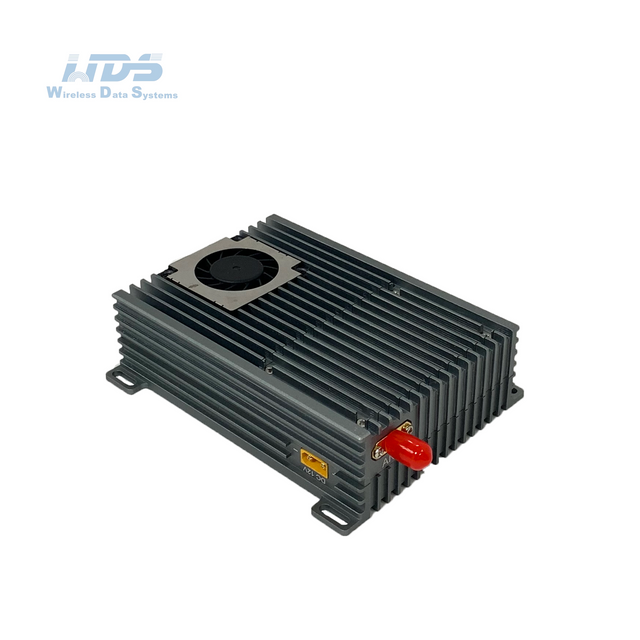
The WDS COFDM HD Video system supports QPSK, 16-QAM, and 64-QAM; FEC rates from 1/2 to 7/8; protection intervals from 1/4 to 1/32; adjustable 2–8 MHz RF bandwidth; and a 2–20 Mbps adaptive stream. Those controls allow one platform to favor resilience, range, or throughput according to the route.
A practical settings hierarchy is:
●Favor continuity with QPSK, stronger coding, a suitable guard interval, and a conservative video rate.
●Favor capacity with higher-order QAM, lighter coding, a shorter interval, and wider bandwidth.
●Preserve margin for the worst repeatable route segment, not merely the average section.
Where OFDM Broadband Still Has the Edge
A Managed Route May Benefit More from Capacity Than Maximum Fade Tolerance
Broadband OFDM can be the better choice when infrastructure controls the path. Elevated base stations, planned antenna sectors, predictable obstructed LOS, and fixed relays reduce the uncertainty that favors heavy protection. Aggregate throughput, return capacity, and efficient sharing may then matter more than preserving one feed through an extreme fade.
The distinction becomes clearer when the mission carries several IP cameras, telemetry, voice, command data, and file transfers. This is a two-way network problem rather than a dedicated contribution-video problem. In that setting, COFDM vs OFDM partly compares continuity-focused video transport with a broader communications architecture. Scheduling, VLAN support, retransmission policies, and traffic prioritization can keep critical services moving as available capacity changes. That flexibility helps several applications share the same RF infrastructure without constant manual retuning.
MIMO and Link Adaptation Can Change the Field Result
MIMO and spatial diversity can improve reliability or throughput when antennas and processing are properly designed. Adaptive modulation lowers the operating mode as channel quality deteriorates, while ARQ recovers packets when the latency budget permits. QoS prevents less urgent traffic from crowding out video or control data.
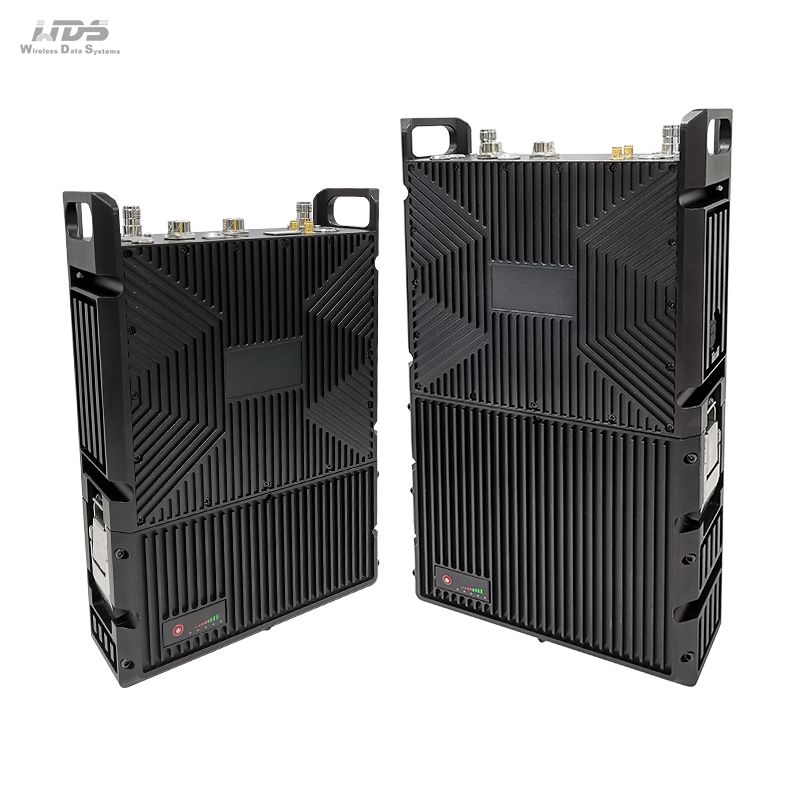
The WDS Outdoor Wireless Broadband Transmission Radio combines OFDM with TDD/TDMA, 2×2 MIMO, selectable channel sizes, dynamic ARQ, adaptive modulation, QoS, and network latency below 10 ms. It is designed for concurrent telemetry, control, data, video, and voice rather than only a dedicated camera feed.
Broadband OFDM is not universally superior; it serves a different priority set. When multi-user capacity and two-way transport dominate, network functions may outweigh maximum video protection. A fair COFDM vs OFDM test must place each system in its intended operating role.
Choose the Link Around the Route, Not the Datasheet Headline
Match the Radio Profile to the Mission
Map the route as clear LOS, obstructed LOS, and full NLOS. Record speed, antenna limits, frequency, bandwidth, and reflective obstacles along the path. Then define resolution, frame rate, video bitrate, end-to-end latency, and recovery time.
Traffic requirements are equally important. A one-way live feed with limited telemetry differs from a bidirectional IP network carrying cameras, voice, control, and bulk data. Power, weight, environmental protection, encryption, and receiver placement should enter the decision before maximum range.
Operating scenario
Main priority
Practical direction
Vehicle in urban streets
Recovery through shadowing and reflections
Favor a robust COFDM-oriented profile
Indoor mobile camera
Multipath tolerance and diversity
Use conservative modulation and strong coding
UAV with mostly clear geometry
Weight, Doppler, video, and return data
Test both architectures in flight
Fixed point-to-point link
Throughput and network capacity
Favor broadband OFDM
Mixed video, voice, control, and telemetry
Two-way traffic management
Prioritize MIMO, QoS, and adaptation
The table is a starting point. Interference, regulation, terrain, and installation quality can reverse an obvious choice. Selection should remain tied to mission thresholds.
Test the Failure Points the Mission Will Actually Encounter
Maximum LOS distance cannot predict performance behind buildings, foliage, terrain, crowds, or moving traffic. A credible test uses the final antennas, cable lengths, mounting positions, frequency, channel width, codec, bitrate, and operating speed. The receiver must also sit where it will be deployed rather than at a convenient elevated location.
Measure freeze count and duration, lowest usable image quality, recovery time, packet loss, decoder resets, mode changes, and full encode-to-display latency. Record position with each result so recurring failures can be connected to route geometry. Both systems must carry comparable image quality and latency to avoid a misleading result.
Do not compare maximum RF throughput with usable video bitrate, or network latency with end-to-end video delay. The COFDM system includes video-oriented parameters and system-delay characteristics, while the broadband radio focuses on network latency and aggregate transport functions. Those values describe different layers and should not be treated as equivalent measurements.
Choose the profile that keeps the picture above the mission threshold for the greatest share of the route and recovers fastest after repeatable blockage. That result is more valuable than a peak rate reached only in open space. It also provides a defensible basis for the final COFDM vs OFDM decision.
Conclusion
The COFDM vs OFDM decision comes down to the channel the video link must survive. COFDM-oriented profiles are often better suited to heavy multipath, changing NLOS conditions, and continuity-critical mobile video, while broadband OFDM systems fit managed paths that demand higher two-way capacity, MIMO, QoS, and mixed IP traffic.
Shenzhen Sinosun Technology Co., Ltd. offers both COFDM HD video equipment and outdoor wireless broadband radios, allowing users to match resilience, latency, and network capacity to the route instead of relying on peak range or bitrate alone.
FAQ
Q: What is the main difference in COFDM vs OFDM?
A: OFDM divides data across orthogonal subcarriers, while COFDM adds channel coding and interleaving to improve recovery when noise, fading, or damaged subcarriers affect reception.
Q: Why does COFDM perform well in multipath environments?
A: Its multicarrier structure, error correction, interleaving, and guard interval help the receiver manage delayed signal copies and recover data lost through frequency-selective fading.
Q: Can COFDM transmit video without a clear line of sight?
A: COFDM can improve video reliability under NLOS conditions by using reflected and diffracted signal paths, although frequency, antennas, obstacles, and link margin still limit performance.
Q: Is COFDM always better than OFDM for mobile video?
A: No. COFDM often suits continuity-critical mobile video, while broadband OFDM may better serve controlled paths requiring higher bidirectional capacity, MIMO, traffic prioritization, or multiple IP services.
Q: How does the guard interval affect wireless video transmission?
A: A longer guard interval increases tolerance to delayed multipath signals but reduces usable data capacity, so it must balance channel conditions against the required video bitrate.
Q: What should be tested before choosing a mobile video link?
A: Test both systems on the actual route using final antennas, operating speed, video settings, and frequency while measuring freezes, recovery time, latency, and usable image quality.