Voice, live video, telemetry, and command traffic often have to share the same wireless links in a mobile ad hoc network, yet they do not tolerate congestion in the same way. Video needs sustained capacity, while voice and control traffic can become unusable when latency, jitter, or packet loss rises.
MANET QoS addresses this problem by giving different traffic types appropriate treatment as routes, link quality, and available bandwidth change. Understanding how to set priorities, manage multi-hop performance, size radio capacity, and test under realistic mobility helps keep critical communications usable when network conditions become unpredictable.
Voice, Video, and Telemetry Need Different QoS Treatment
Voice Depends More on Timing Than Bandwidth
Voice and push-to-talk traffic usually require far less capacity than a high-definition video feed, yet they can become unusable much sooner when network timing deteriorates. Packets that arrive too late do little good to a real-time conversation, while unstable arrival intervals force receivers to absorb more delay or accept audible gaps.
For interactive speech, end-to-end delay should therefore be treated as a primary design variable. Keeping one-way latency around or below 150 ms is a commonly used target for maintaining natural conversational interaction, although the acceptable value depends on the application. Jitter matters as well because changing packet arrival intervals can indicate congestion and force larger receive buffers.
For MANET QoS, that means protecting voice queues from long waits is often more valuable than allocating them a large share of total bandwidth. A link with plenty of theoretical throughput can still produce poor speech if relay queues or retransmissions create unpredictable delay.
Video Needs Sustained Capacity Without Taking Over the Link
Live video has a different profile. It needs sustained throughput, but usable quality also depends on loss, delay, and delivery consistency. If a stream cannot obtain enough capacity, the effects may appear as reduced resolution, frame drops, compression artifacts, freezes, or an increasing gap between the event and what the operator sees.
Real-time situational video should also be distinguished from buffered entertainment streaming. A buffered player can trade delay for smooth playback. A UAV camera, remote inspection feed, or tactical observation stream usually cannot accumulate several seconds of buffer without reducing operational value.
Rate adaptation is useful here. Real-time video applications can reduce their transmission rate when available capacity falls or congestion increases. In a mixed MANET, lowering video bitrate is often preferable to allowing the encoder to keep filling queues until voice or control latency rises sharply.
Telemetry and Control Can Be Small but More Important
Packet size is a poor indicator of priority. A control instruction or navigation update may contain only a few bytes, yet a delayed command can matter more than thousands of video packets.
Routine telemetry and command-and-control traffic should not automatically be treated as one class. Periodic temperature, battery, or status updates may tolerate modest delay. Flight-control messages, steering commands, safety alerts, or other interactive instructions may require much more predictable forwarding.
The useful rule for MANET QoS is to rank traffic according to the consequence of late or missing information rather than bandwidth consumption.
Traffic
Main QoS Need
Secondary Need
Typical Problem When QoS Fails
Voice / PTT
Low delay and jitter
Low packet loss
Delayed or broken speech
Live video
Sustained throughput
Delay and loss control
Freeze, artifacts, growing lag
Telemetry
Delivery consistency
Low loss
Missing or stale updates
Command/control
Predictable low delay
Reliability
Slow or missed response
Build a Priority Policy That Still Works Under Congestion
Decide Which Traffic Gets Protected First
A useful priority policy begins before congestion occurs. Instead of labeling every real-time application as “high priority,” decide what must remain responsive when the radio network cannot satisfy all offered traffic.
A representative hierarchy might place safety-critical command traffic first, followed by interactive voice and essential telemetry, while allowing video to consume a larger portion of remaining capacity. That order is not universal. In an unmanned aircraft, certain flight-control traffic may clearly outrank PTT voice; another deployment may make operator communications more important than routine sensor updates.
DSCP or comparable classification can support the policy, but packet marking is only the identification step. Telephony, signaling, multimedia conferencing, real-time interactive traffic, streaming media, and background data have different performance requirements, so applying one forwarding treatment to every packet provides little protection when congestion begins.
Prevent High-Bitrate Video From Starving Smaller Critical Flows
Priority without traffic control can create another problem: an overloaded high-priority class can consume the resources intended to protect everything else.
A stronger MANET QoS policy combines classification with queue scheduling, bandwidth allocation, shaping or rate limits, and admission control where the platform supports them. Schedulers can impose minimum or maximum rates on queues, allowing the network to protect critical flows without handing unlimited capacity to a single class.
Video is the clearest example. It may be permitted to use substantial spare capacity during favorable conditions, yet its maximum rate can be constrained when several real-time services compete. Adaptive encoding provides an additional response: rather than building a long video queue during a capacity drop, the application can lower its bitrate and preserve timely delivery for smaller critical flows.
Keep QoS Useful When Routes and Link Conditions Change
Judge QoS End to End, Not One Hop at a Time
Single-hop measurements are useful, but applications experience the entire route.
Every additional relay can introduce medium-access contention, processing time, queueing, retransmissions, and another opportunity for interference or weak signal conditions. A six-millisecond radio hop does not imply a six-millisecond application path if a packet must cross several loaded relays.
For that reason, MANET QoS should be evaluated using end-to-end measurements. Average latency is useful for establishing a baseline, but percentile or worst-case observations reveal the short spikes that can disrupt speech, delay commands, or make a live video feed feel detached from real events. Jitter should also be observed over time because packet timing variation can change quickly as congestion, route conditions, and RF quality shift.
Do Not Choose Routes by Hop Count Alone
A three-hop path is not necessarily better than a four-hop path. One of those three links may be congested, unstable, heavily interfered with, or operating near the edge of usable RF conditions.
Routing decisions that support real-time performance should therefore consider more than distance expressed as hop count. Relevant inputs may include available capacity, packet loss, link quality, current congestion, delay, and the likelihood that a link will remain usable as nodes move.
Effective link capacity must also account for losses caused by medium access, retransmissions, and changing RF conditions. Topology changes and mobility affect the calculation further. The shortest-looking path can therefore be the wrong path if one relay becomes the bottleneck.
Treat Route Recovery as Part of QoS
Mobility adds another metric that conventional QoS discussions sometimes overlook: recovery time.
When a moving node breaks an active route, the relevant question is not merely whether an alternate path eventually exists. Operators need to know how long voice is interrupted, how many telemetry updates are missed, whether command response pauses, and how long video takes to resume.
Hard end-to-end guarantees are difficult when topology and RF conditions can change rapidly. A more practical MANET QoS target is predictable differentiation combined with fast adaptation. The network should recognize path deterioration, find a usable alternative, and restore higher-priority traffic before a short topology change becomes a long application outage.
Make Sure the Radio Network Can Support the QoS Policy
Size Capacity for Simultaneous Traffic, Not Peak Data-Rate Claims
QoS scheduling cannot manufacture radio capacity. Before assigning queues, estimate the traffic that will actually coexist.
A deployment model might include two live video feeds, several PTT users, recurring telemetry, command traffic, routing overhead, and occasional file transfers. Capacity planning should then include margin for retransmissions, changing modulation, interference, mobility, and mesh forwarding rather than assuming every link continuously operates at its best data rate.
Relay nodes deserve particular attention. A radio that appears lightly loaded as an endpoint can become a bottleneck when it forwards traffic from several other nodes. As the mesh changes, that aggregation point may also move. Planning MANET QoS around nominal source rates alone can therefore hide the point where congestion will first occur.
Look Beyond QoS Settings to RF and Mesh Behavior
Queue configuration operates on the capacity the wireless layer makes available. MIMO techniques, modulation behavior, interference management, channel selection, and routing resilience all affect how much usable capacity is available for the traffic scheduler.
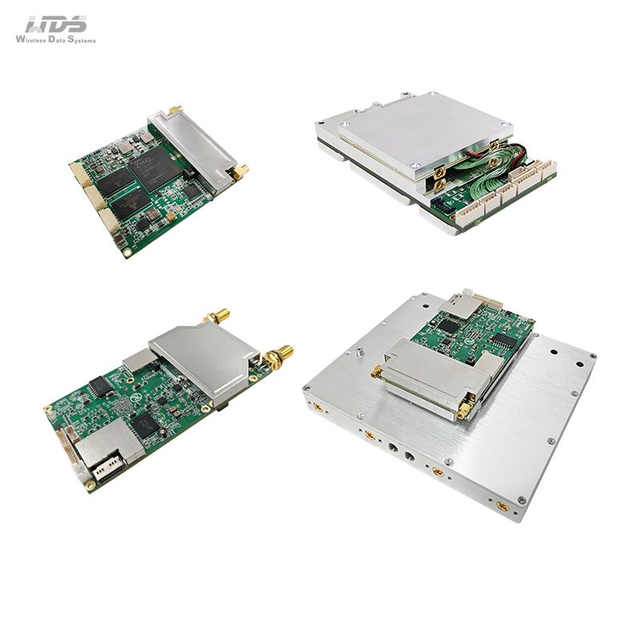
WDS MIMOmesh provides one example of how adaptive MANET QoScan operate alongside MIMO networking, dynamic routing, and multi-hop connectivity.
It combines MANET and MIMO networking with adaptive QoS data rates, dynamic Layer 2 or Layer 3 routing, multi-hop relay operation, and adaptive modulation. An average one-way single-hop delay of 6 ms at 20 MHz bandwidth is supported alongside spectrum scanning, intelligent frequency selection, and adaptive frequency-hopping capabilities. These characteristics do not replace QoS policy, but they help establish the RF and routing conditions in which that policy operates.
The same principle applies to airborne systems. WDS DDLmesh can carry HD video alongside bidirectional flight-control, GPS, voice, and other data. Adaptive QoS data rates, dynamic routing, multi-hop relay capabilities, and an average 6 ms one-way single-hop delay at 20 MHz help support mixed traffic across a changing wireless topology. Application requirements and radio behavior therefore need to be engineered together rather than treated as separate tasks.
Test MANET QoS Under the Conditions That Actually Cause Failure
Run Voice, Video, and Telemetry Together
Testing each application separately produces reassuring numbers that may disappear as soon as the network carries a realistic workload.
A meaningful MANET QoS test should generate voice or PTT, live video, telemetry, command traffic, and representative background data simultaneously. Offered load can then be raised in controlled steps until queues begin to build or available radio capacity falls below demand.
The key observation is not simply the maximum throughput reached. Engineers should record which application degrades first. If video consumes the link until command latency spikes, the priority model is not doing what it was designed to do. If video bitrate decreases while command packets and speech remain timely, the system is showing the intended behavior.
Add Mobility, Extra Hops, and RF Stress
The next stage is to disturb the network deliberately. Compare a direct connection with two-, three-, and multi-hop paths. Move nodes until active links change. Add obstruction or interference, reduce signal margin, and place simultaneous traffic through the same relay.
Measure end-to-end latency, jitter, packet loss, usable throughput, and route-recovery time throughout the test. Application-level observations matter just as much: note voice interruptions, video freezes or lag, irregular telemetry intervals, and delayed command responses.
Testing under changing topology, variable link capacity, realistic traffic patterns, and node mobility exposes problems that remain hidden in static conditions. It also provides a more representative view of how a multi-hop wireless network will behave after deployment than an idle speed test or a fixed single-link benchmark.
Define Success as Graceful Degradation
A robust mobile network does not need to maintain maximum performance for every service under every possible condition. It needs to fail in a controlled order.
Under severe congestion, a video encoder might drop to a lower bitrate or frame rate. Background transfers may slow dramatically. Routine telemetry could tolerate slightly longer intervals. Critical control packets and voice, however, should continue receiving the forwarding treatment established by the mission policy.
That is a more useful acceptance criterion for MANET QoS than a headline throughput figure:
Test Scenario
Voice
Video
Telemetry / Control
Normal traffic
Establish delay/jitter baseline
Confirm stable stream
Confirm update intervals
Near-capacity load
Check responsiveness
Watch bitrate and lag
Verify priority delivery
Additional hops
Measure delay growth
Check continuity
Measure timing variation
Route change
Measure interruption
Measure freeze/recovery
Check missed updates
RF interference
Monitor loss and jitter
Watch artifacts
Verify command reliability
The final test should push the network beyond comfortable operating conditions. When the resource shortage becomes unavoidable, the behavior of the traffic classes shows whether the QoS design is actually protecting operational priorities.
Conclusion
Effective MANET QoS depends on matching network resources to the different needs of voice, video, telemetry, and control traffic. Prioritization, capacity planning, route resilience, and realistic multi-hop testing all help critical communications remain usable when congestion, mobility, or interference changes network conditions.
Shenzhen Sinosun Technology Co., Ltd. offers MANET and wireless data-link solutions designed for mixed video, voice, and data transmission. By combining adaptive QoS capabilities with dynamic routing and multi-hop connectivity, these systems can help operators maintain more predictable communications while making better use of available wireless capacity.
FAQ
Q: What does MANET QoS improve in a mobile ad hoc network?
A: MANET QoS helps prioritize traffic according to application needs, reducing the impact of congestion on delay-sensitive voice, live video, telemetry, and command communications.
Q: Which QoS metrics matter most for voice and video in MANETs?
A: Latency, jitter, packet loss, and usable throughput are the main metrics. Voice is especially delay-sensitive, while video depends more heavily on sustained bandwidth and delivery consistency.
Q: Why is QoS harder to maintain in MANETs?
A: Mobile nodes constantly change network topology and route quality. Interference, limited wireless capacity, multi-hop forwarding, and retransmissions can also change application performance within short periods.
Q: Should voice, video, and telemetry receive the same priority?
A: No. Priority should reflect operational importance and traffic behavior. Command traffic may need the lowest delay, voice needs predictable timing, while video can often tolerate adaptive bitrate reductions.
Q: How should MANET QoS performance be tested?
A: Test mixed traffic under realistic congestion, mobility, interference, and multi-hop conditions. Measure end-to-end latency, jitter, loss, throughput, route recovery, and application behavior during network changes.