A MANET can carry a clear PTT call one moment and struggle the next as nodes move, routes gain hops, or a video stream consumes shared airtime. Because wireless capacity is variable and realized throughput often falls below the radio’s nominal rate, treating every packet equally can quickly degrade command delivery, telemetry freshness, and voice intelligibility.
Effective MANET QoS starts by matching each traffic type to its operational value and tolerance for delay, loss, and congestion. The sections ahead show how to prioritize PTT voice, command, telemetry, and video while keeping the mesh responsive as conditions change.
Set the Traffic Order Before Touching the Queues
Judge Traffic by Mission Impact and Time Sensitivity
Traffic priority should reflect what happens if a message arrives late and how the application reacts to delay or loss. PTT voice is highly delay-sensitive, but a small emergency command may carry greater mission impact. Critical telemetry can expire quickly, routine reports can tolerate batching, and video can often reduce bitrate or resolution.
Network-control traffic needs separate protection because routing and topology maintenance keep the forwarding fabric alive. Network control, telephony bearer, signaling, real-time interactive traffic, and adaptive multimedia require different service classes rather than one broad “critical” class. A sound MANET QoS policy follows the same principle: classify traffic by required behavior, not by a vague importance label.
Start with a Defensible Priority Ladder
A practical starting order is:
1. Routing, synchronization, and network-control traffic.
2. Emergency commands and PTT signaling.
3. PTT voice bearer traffic.
4. Critical telemetry and alarms.
5. Rate-controlled operational video.
6. Routine telemetry, file transfer, and background data.
This hierarchy is not permanent. A reconnaissance phase may temporarily elevate one video stream, while an evacuation phase may protect position updates and voice more aggressively. Overrides should be explicit, bounded, and removed when the mission phase ends. The hierarchy also keeps mesh survival functions above user traffic when capacity collapses.
A MANET QoS policy also needs a rate boundary. High-priority service should provide predictable forwarding within an engineered envelope, not unlimited transmission. Otherwise, simultaneous voice sessions or misclassified traffic can fill the strict queue and damage command, telemetry, and routing performance.
Give Each Traffic Type the Treatment It Actually Needs
Keep PTT Voice Fast—but Put a Ceiling on It
PTT bearer traffic belongs in a bounded low-latency queue because spoken coordination loses value when packets wait behind large data frames. Expedited Forwarding is a common starting behavior for controlled-rate voice because it supports low-delay, low-jitter, and low-loss service when the aggregate is served at a configured rate. That rate boundary is essential.
In MANET QoS, PTT signaling or floor-control packets should be classified separately when the system exposes them. A short request-to-talk or grant may be more urgent than the continuing audio stream. Admission control, session limits, or policing can prevent too many talk groups from consuming protected airtime.
Split Command and Telemetry into Meaningful Classes
Command traffic needs high-assurance, low-delay forwarding without being trapped behind uninterrupted voice. Small queues and expiry rules help prevent outdated instructions from arriving after conditions change. Acknowledgements need comparable treatment because a fast command is not useful if confirmation is delayed.
Telemetry should be divided into critical and routine classes. Alarms, abrupt position changes, faults, safety states, and control feedback belong in the critical class; periodic health and environmental reports can use aggregation, burst limits, or longer intervals. MANET QoS should protect freshness, not merely packet delivery.
Signaling, telephony, and real-time interactive control benefit from separate treatment because their packet sizes, arrival patterns, and delay requirements differ. A MANET QoS deployment may choose different codepoints, but its queues should preserve those functional distinctions. Routine data should never inherit urgency merely because it originates on the same endpoint.
Make Video the First Major Flow to Adapt
Video should receive assured bandwidth rather than unrestricted strict priority. Adaptive interactive video can fit an AF4x-style class, while inelastic real-time video may justify CS4-like treatment. The final mapping depends on the encoder, stream behavior, and mission requirements.
Traffic class
Practical treatment
Congestion response
Network control
Protected high-assurance queue
Preserve; limit excess overhead
PTT signaling and urgent command
Short low-delay queue
Preserve; expire stale packets
PTT voice bearer
Bounded priority or EF-like queue
Reject new sessions first
Critical telemetry
Reserved low-delay service
Preserve freshness
Operational video
Assured, rate-limited queue
Lower bitrate, frame rate, or resolution
Routine data
Best-effort service
Delay, batch, or suspend
In MANET QoS, video degradation should happen in stages: reduce bitrate, then frame rate or resolution, and finally suspend secondary feeds. Where the codec exposes packet importance, metadata, control information, and essential picture data should survive ahead of enhancement traffic.
Keep Priorities Intact Across a Moving Multi-Hop Mesh
Enforce the Policy at Every Relay
Source marking alone does not create end-to-end MANET QoS. Every relay that can become congested must classify, queue, and schedule traffic consistently, or marked voice may still wait behind a video burst at the next hop. Trust boundaries also prevent endpoints from labeling background traffic as urgent command or network control.
MANET QoS capacity decisions must be based on the complete path. Throughput varies with medium access, fading, noise, interference, retransmissions, and changing topology. A stream that fits across one hop may consume repeated airtime across several relays and reduce capacity for nearby flows. Queue alignment across those relays prevents one weak hop from undoing the policy applied elsewhere.
Routing and topology updates require reserved service as well. If congestion delays the packets needed to maintain routes, recovery slows and application queues grow. Protecting network control therefore supports every other MANET QoS class.
Change the Load as the Route Changes
A static admission decision becomes unsafe when a route gains hops or retransmissions rise on a weak link. Queue depth, route length, link quality, retransmission rate, and estimated capacity should trigger a staged response. Reduce video first, pause secondary feeds, slow routine telemetry, and reject new nonessential sessions before harming command, critical telemetry, or bounded PTT service.
Freshness limits should apply to commands, location updates, and sensor values. Once information exceeds its operational lifetime, dropping it is safer than spending airtime on stale data. This is especially useful after route changes, when buffered packets may outlive their value. Re-admission checks should also run when the selected path changes materially.
QoS cannot create spectrum or repair a broken path. It makes scarcity predictable by removing the least damaging traffic first. A policy that never adapts to topology change is not a complete MANET QoS strategy.
Turn the Policy into Ground and Airborne Profiles
A Ground Profile for PTT-Led Team Communications
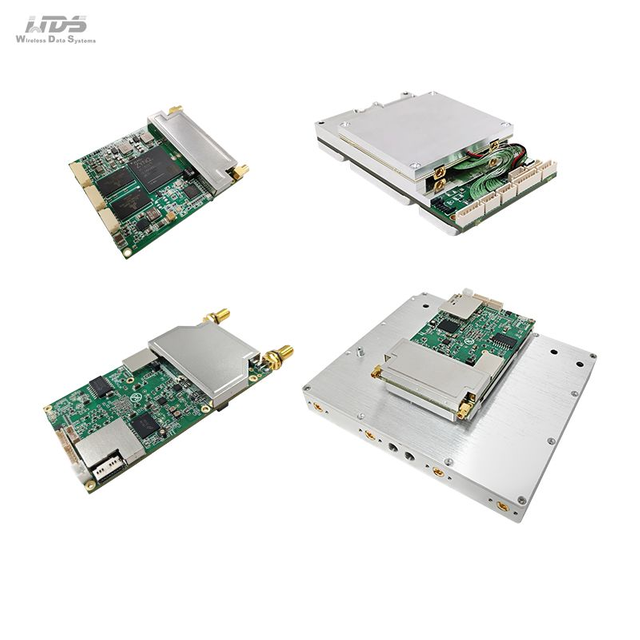
A ground profile should center on PTT signaling, voice, dispatch commands, position updates, and one controlled video stream. The WDS MIMO-BP combines PTT, Ethernet and serial interfaces, selectable service priority, optional low-delay video, and management visibility for topology, signal quality, and traffic. These functions support a practical profile rather than a single undifferentiated queue.
Floor-control messages should cross video bursts quickly, active voice should receive bounded low-latency service, and critical location changes should remain protected. When link quality falls or the route lengthens, the node can shift to a restrictive MANET QoS profile that reduces video and routine reporting before coordination suffers. Management data such as topology and signal-to-noise ratio can help trigger that switch.
An Airborne Profile That Protects Control First
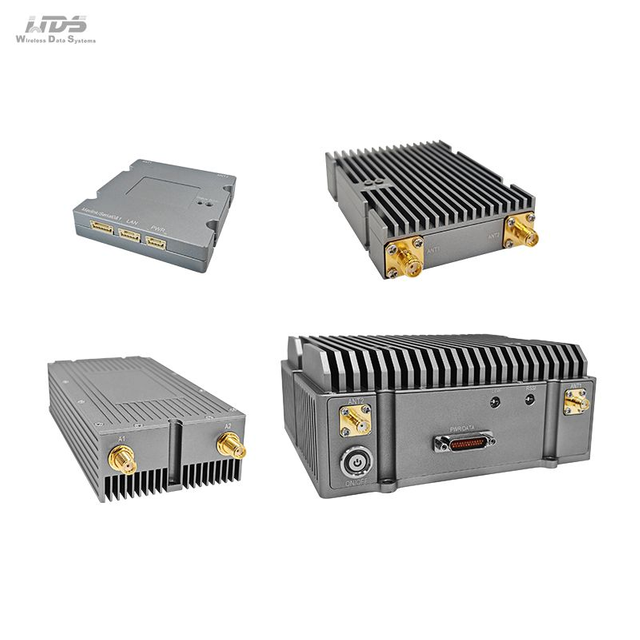
An airborne profile should put flight or payload commands, acknowledgements, and critical telemetry ahead of image quality. The WDS MIMO-AB supports Ethernet and serial transport, MAVLink, selectable service priority, and optional low-delay video interfaces. Those interfaces allow control and payload traffic to share one node without sharing one treatment.
Video bitrate should fall as soon as route quality deteriorates, not after command timeouts appear. An average 6 ms unidirectional single-hop delay under a 20 MHz configuration is a component-level performance figure rather than an end-to-end guarantee across a moving route. Airborne MANET QoS planning must include relay count, queuing, retransmissions, and the complete control loop.
Test the Moments When the Policy Is Most Likely to Fail
Reproduce Congestion, Movement, and Traffic Bursts
A clean one-hop throughput test cannot validate MANET QoS. The test plan should combine several users pressing PTT with peak-rate video, a relay leaving range during a call, a route gaining hops, simultaneous sensor alarms, and competing ground and airborne feeds. Weak, asymmetric, or interference-affected links also matter because MANET topology and realized capacity can change rapidly. Tests should include recovery, not only failure, so engineers can see whether priorities return to normal after the route stabilizes.
Repeat each scenario with different node counts, mobility patterns, traffic mixes, and offered loads. The goal is to identify the point at which each service begins to fail, not to produce one favorable benchmark. That boundary reveals whether admission limits, queue sizes, and degradation rules match the real network. It also exposes whether a temporary priority override remains active longer than intended.
Measure Outcomes by Service, Then Tune in the Right Order
PTT tests should record floor-acquisition time, delay, jitter, loss, and intelligibility. Command evaluation needs acknowledgement time, delivery percentiles, timeouts, and stale-command drops; telemetry should be judged by update age and missed alarms. Video metrics should include end-to-end delay, usable frame rate, adaptation speed, and recovery after route changes, while mesh health should track convergence, retransmissions, queue depth, per-class drops, and control overhead.
Tuning should follow the packet path. Confirm classification first, verify markings at every relay, inspect queue limits and scheduling, adjust admission controls and rate caps, then tune video adaptation and reassess radio or routing conditions. This order separates policy errors from path failures and makes MANET QoS results easier to reproduce. Retest the original overload case after every change rather than accepting improvement in an unrelated scenario.
Conclusion
Reliable MANET QoS depends on more than placing voice above video. Network control, urgent commands, PTT signaling, critical telemetry, and adaptive video each need treatment that reflects their operational value, delay tolerance, and bandwidth demand. Policies should also adjust as hop count, congestion, and link quality change.
Shenzhen Sinosun Technology Co., Ltd. offers MIMOmesh backpack and airborne radio platforms that support mixed voice, control, telemetry, and video deployments. Used with disciplined traffic classification, bounded priority queues, and realistic field testing, these systems can help teams preserve essential communications when wireless capacity becomes limited.
FAQ
Q: What is MANET QoS?
A: MANET QoS manages limited wireless resources by classifying and prioritizing traffic according to bandwidth, delay, jitter, packet-loss, and reliability requirements across changing multi-hop routes.
Q: Why is QoS difficult to maintain in a MANET?
A: Node mobility, route breaks, shared radio channels, interference, and changing link capacity make end-to-end performance less predictable than in fixed networks.
Q: Which traffic should receive the highest priority?
A: Network-control packets, urgent commands, and PTT signaling generally need protection first, followed by bounded voice, critical telemetry, rate-controlled video, and routine data.
Q: Should PTT voice always take priority over video?
A: PTT voice usually needs lower delay and jitter, but its priority queue should be rate-limited so continuous calls cannot block commands, telemetry, or routing traffic.
Q: Which metrics are most useful for evaluating MANET QoS?
A: Useful measurements include end-to-end delay, jitter, packet loss, throughput, route convergence, retransmissions, queue depth, command acknowledgement time, telemetry freshness, and usable video frame rate.
Q: Can QoS guarantee reliable performance when MANET routes change?
A: QoS improves traffic treatment during congestion, but it cannot create bandwidth or prevent route failure. Policies must adapt when hop count, interference, or link quality changes.