A WAN outage does not always mean the local network has failed. Radios, cameras, sensors, vehicles, and drones may still exchange traffic even when the LTE path to the core, cloud, or remote command center is unavailable. LTE architectures separate the radio access network, transport backhaul, and core, while MANET routing supports changing wireless topologies.
The decisive issue is whether local routes and essential applications remain inside the surviving network boundary. A resilient hybrid MANET LTE design keeps nearby traffic moving, preserves critical edge services, and controls how data is queued and restored when WAN connectivity returns.
When LTE Drops, Which Services Stay Available?
Draw the failure boundary before judging resilience
“LTE is down” may mean lost Internet access, a break between the radio network and core, a powered-off gateway, or a missing MANET relay. Each fault removes a different part of the path and produces a different result.
A strong signal indicator confirms radio contact, not remote-service reachability. LTE networks contain distinct device, radio-access, transport-backhaul, and core layers, so an upstream fault may interrupt remote services while field equipment remains powered and connected to a nearby cell. A hybrid MANET LTE system should monitor end-to-end connectivity instead of treating cellular registration as proof of WAN health.
LTE-based local service also needs an architecture designed for isolated operation when the wider core is unavailable. This capability is not automatic in every deployment and must be validated separately from MANET continuity.
Separate local applications from remote dependencies
In a hybrid MANET LTE deployment, services survive when endpoints, routes, and applications stay inside the local boundary. Push-to-talk, nearby video, position exchange, telemetry, sensor control, and file transfer can continue if they do not call an off-site server. Cloud dashboards, remote databases, Internet access, and off-site dispatch normally stop when the external path disappears.
Some tools remain partly useful. Cached maps may stay readable, stored credentials may permit temporary access, and local recorders may keep capturing video. Store-and-forward queues can preserve reports or telemetry for later upload if they retain timestamps, identifiers, and enough storage.
The expected result should be documented for every operational service before deployment.
Service
Main dependency
Likely outage behavior
Local voice
Local endpoints and voice service
Continues inside the mesh
Field video
Local camera, route, and viewer
Continues locally; remote viewing stops
Telemetry
Local broker or peer application
Continues or queues
Cloud dashboard
LTE backhaul and remote platform
Becomes unavailable
Remote identity
Off-site authentication
May block access without offline support
Why Local MANET Paths Keep Working Without the WAN
Local packets do not need to cross the LTE gateway
A MANET node can discover neighbors, select routes, and forward packets instead of relying on one fixed central router. When a vehicle moves behind terrain or an airborne relay changes position, the network can calculate another path through reachable nodes. The LTE gateway is therefore an exit from the local topology, not necessarily its center.
Consider an airborne camera sending video to a command vehicle. Packets may travel through a portable relay to the viewer without touching LTE. If the cellular route disappears, that path can remain valid because neither endpoint depends on the WAN.
This separation gives hybrid MANET LTE architecture its resilience. A gateway-dependent layout makes one device both the WAN exit and a local point of failure. A distributed layout keeps nearby traffic inside the mesh and uses LTE only for remote destinations.
Useful disconnected operation requires local services
Routing continuity alone does not guarantee useful operations. Radios may exchange packets while applications fail because the voice controller, map database, telemetry broker, or identity service sits off-site. The surviving boundary of a hybrid MANET LTE network must contain the functions required during the outage.
Useful edge services may include local voice, mission maps, video recording, telemetry processing, and selected naming, time, or authentication functions. Their placement should be tested by isolating or powering off the LTE gateway. Hosting every local application on that gateway can still create a complete service failure.
Caching and hosting solve different problems. A cache preserves earlier content, while a locally hosted application accepts new positions, messages, and video. Remote-bound data should enter a store-and-forward workflow and synchronize later without losing order or provenance.
How Traffic Changes Before, During, and After an Outage
Normal operation: keep local traffic local
Healthy LTE service should not pull every packet through the cellular gateway. Nearby voice, telemetry, control traffic, and video belong on MANET routes, while cloud synchronization, remote command access, Internet services, and off-site users use LTE. This split lowers latency and prevents local sessions from inheriting WAN availability.
Hybrid MANET LTE route policy should make that intent explicit. Local subnets and edge services need preferred MANET paths, while a default route or selected remote prefixes point toward the LTE gateway. With several gateways, metrics can choose the best exit without changing local routing.
Traffic classification matters too. Safety alerts and command voice should not compete equally with bulk uploads, updates, or several high-rate video streams. Service priorities should be defined before congestion begins.
Outage response: remove the failed route without disturbing the mesh
A hybrid MANET LTE gateway should test reachability beyond the modem because signal strength may remain normal during an upstream failure. Health checks can use multiple targets, loss thresholds, and a hold-down period to avoid route flapping. Once the WAN is unusable, the gateway withdraws or deprioritizes the external route while leaving local MANET routes intact.
Remote-bound traffic then follows a defined policy:
●Queue essential telemetry, logs, and reports.
●Reduce or stop video intended only for remote viewers.
●Suspend background transfers and software updates.
●Show a clear disconnected status.
Local sessions should continue when their endpoints and services remain in the mesh. Cloud sessions may time out because the destination has disappeared. Routing cannot preserve an application session whose server is unreachable.
Restoration: prevent the returning link from becoming a bottleneck
In a hybrid MANET LTE system, a restored signal should not immediately reclaim the preferred route. The gateway should verify stable end-to-end service, then reintroduce LTE after a recovery interval. This reduces oscillation when coverage is unstable.
Backlogged data can cause congestion if every recorder and sensor uploads at once. Current voice, control, and live telemetry should retain priority, while historical video and logs return in paced batches. Rate limits and randomized retries help the hybrid MANET LTE network recover without saturating the backhaul.
Timestamps, message identifiers, ordering rules, and conflict handling keep delayed information separate from live data. Recovery is complete only when the route is stable and queued data is synchronizing without disrupting current operations.
Build the Network Around the Failure Boundary
Keep critical functions away from single points of failure
Decide what must remain usable if the LTE gateway loses its WAN link, then repeat the exercise for complete gateway failure. Applications hosted elsewhere may survive the first event, while gateway-hosted services may disappear in the second. Critical tools should sit on a reachable edge platform or be replicated when one device cannot be allowed to remove them.
A hybrid MANET LTE topology also needs more than one practical route between important teams. Terrain, antenna orientation, movement, or buildings can leave one relay carrying nearly all traffic. Field trials should identify these convergence points.
WAN redundancy belongs to a separate layer. Multiple LTE-capable gateways can improve remote reach, but dual-SIM designs do not repair a weak MANET route. A resilient hybrid MANET LTE deployment must also remove cloud dependencies in authentication, management, addressing, and licensing.
Protect airtime for the traffic that matters
Mesh capacity is set by the busiest shared path, not the highest rate of one clean link. Every relay transmission consumes airtime, and several streams may converge before reaching a command post. Planning should model realistic hops, users, video profiles, and interference.
In hybrid MANET LTE traffic policy, safety alerts and command voice usually come first, followed by position and control data, selected video, then files and background synchronization. QoS cannot create bandwidth, but it can prevent large transfers from blocking urgent traffic.
Power and RF geometry also shape routing. Batteries, antenna height, spectrum choice, and relay placement determine whether an alternate path exists. MANET routing cannot use equipment that is unpowered, overloaded, or out of range.
Give ground and airborne nodes different jobs
A portable ground node can anchor a command post, connect Ethernet or serial equipment, provide a stronger relay, and act as the LTE exit. An airborne unit can improve line of sight, bridge terrain-separated groups, and carry drone video while adding another path.
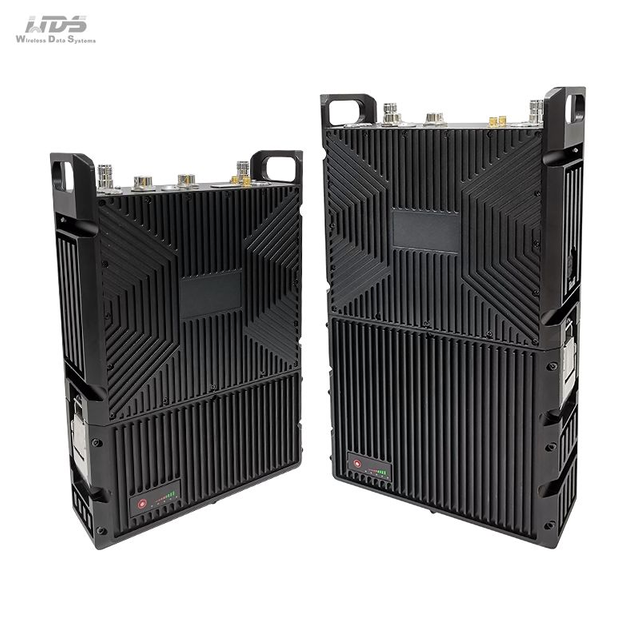
Within a hybrid MANET LTE deployment, the WDS Powerful Backpack Series can serve as a portable ground gateway or high-power relay. Its capabilities include distributed centerless operation, Layer 2 or Layer 3 dynamic routing, multi-hop relay, service prioritization, Ethernet and serial interfaces, battery-powered deployment, and optional public-network or 4G LTE routing.
For an airborne hybrid MANET LTE role, the WDS Lightweight Airborne Series can support dynamic routing, multi-hop operation, QoS, Ethernet and serial connectivity, MAVLink integration, and optional 4G LTE expansion. Its main role is to improve RF geometry without forcing local traffic through the WAN.
Aircraft landing or battery depletion must still be considered. An airborne node that forms the only bridge between ground groups becomes another failure point. Airborne relays should strengthen a sound ground topology rather than conceal the absence of one.
Prove the Failover Before It Is Needed
Test a real workload, not just network pings
A successful ping says little about hybrid MANET LTE voice continuity, video recovery, application state, or queued data. Start with representative voice, mapping, telemetry, local video, remote video, and cloud sessions active. Remove the upstream WAN while keeping MANET nodes powered, then record which services continue, degrade, reconnect, queue information, or stop.
The next run should combine faults. Move or power down a relay during the outage, restore LTE under load, and repeat the exercise with the entire gateway switched off. This exposes gateway-hosted dependencies and topologies with only one usable relay.
Use service-level pass criteria
Hybrid MANET LTE acceptance criteria should describe what users can do, not only what a network manager can see. Measure WAN-failure detection, route convergence, voice interruption, packet loss, video recovery, local application availability, queued-data integrity, and congestion after restoration. Thresholds should match the mission and traffic profile.
Test event
Required observation
Upstream WAN loss
Local routes and edge services remain available
Gateway reboot
Approved local functions survive or recover
Relay loss
An alternate path forms within the target window
WAN restoration
Current traffic stays ahead of backlog
Congested recovery
Voice, control, and live telemetry remain usable
A hybrid MANET LTE network is ready only after these results are repeatable under realistic movement, terrain, interference, and power conditions. Failed criteria should trigger changes in topology, application placement, traffic policy, or gateway redundancy. Testing turns self-healing from a feature claim into an observable capability.
Conclusion
Resilience in a hybrid MANET LTE network depends on keeping local routes, essential edge services, and traffic priorities independent of the WAN. When LTE fails, the mesh should continue carrying voice, video, telemetry, and control data locally, then restore remote connectivity without overwhelming the returning backhaul.
Shenzhen Sinosun Technology Co., Ltd. offers MIMOmesh backpack and lightweight airborne radios for ground gateways, mobile relays, and elevated links. Used with sound routing, edge-service placement, and outage testing, these products can help teams maintain local communications and restore external connectivity with less disruption.
FAQ
Q: What happens when LTE backhaul fails?
A: The network loses access to remote cloud, core, and Internet services. Local MANET routes can continue carrying traffic if essential applications and supporting services remain inside the mesh.
Q: Can a hybrid MANET LTE network work without Internet access?
A: Yes. Nearby nodes can communicate through direct or multi-hop MANET routes without the Internet. LTE is required only for destinations and services beyond the local network.
Q: Which services can remain available during a WAN outage?
A: Local voice, video, telemetry, position sharing, sensor control, and file exchange may continue. Cloud dashboards, remote databases, off-site dispatch, and Internet-dependent authentication usually become unavailable.
Q: Does a strong LTE signal confirm backhaul connectivity?
A: No. A device may remain registered to a nearby cell while the transport backhaul, mobile core, or Internet path is unavailable. End-to-end health checks are more reliable.
Q: How does MANET reroute traffic after a node or gateway failure?
A: MANET routing discovers reachable neighbors and recalculates multi-hop paths as topology changes. Losing the LTE gateway removes external reach, while local traffic can use alternative mesh routes.
Q: How should WAN failover be tested?
A: Run voice, video, telemetry, and cloud sessions, then disconnect the WAN and remove a relay. Measure route convergence, service interruption, queued data, and recovery congestion.