A wireless mesh can show strong RSSI, stable links, and full connectivity while still slowing down the moment several nodes transmit at once. The problem may not be coverage at all. Hidden nodes can reach the same relay without reliably sensing each other, creating collisions, retries, and unpredictable latency that are easy to mistake for interference or routing faults.
In a Wireless Mesh Radio network, these effects can spread beyond one link because traffic may cross multiple relays. Understanding the pattern helps operators diagnose the real cause, choose the right mitigation, and avoid unnecessary RF changes.
Why One Hidden Pair Can Slow Down an Entire Mesh
When carrier sensing fails between two transmitters
Consider three radios: A, B, and C. Nodes A and C can both communicate with relay B, but A and C cannot hear each other because of distance, terrain, structures, antenna geometry, or unequal propagation. When A listens before transmitting, it hears no activity from C. At almost the same moment, C can make the same decision because A is also outside its sensing range.
Both transmissions then reach B together. The receiver may be unable to decode either frame correctly, acknowledgments are missed, and the sending nodes enter backoff and retry. Repeated transmissions toward a common receiver can continue to collide when the two transmitters remain unable to sense one another. Hidden relationships can also be asymmetric, meaning one node may detect another even when that detection does not work in the opposite direction.
This is why good signal readings to the relay do not rule out a hidden node. A strong A-to-B link says little about whether A can detect C. In a Wireless Mesh Radio deployment, carrier-sensing relationships therefore matter separately from the quality of the forwarding links themselves.
Why multi-hop forwarding amplifies the damage
A collision in a single-hop network wastes airtime on one local exchange. In a mesh, the same failed packet may still need to cross several additional hops after it is successfully retransmitted. Time lost at one relay can therefore delay downstream forwarding even when the rest of the route is functioning normally.
The effect becomes more noticeable when a relay aggregates traffic from several branches. Retransmission attempts, random backoff, and repeated channel access consume airtime that other mesh links also need. Hidden nodes become especially disruptive in multi-hop environments because forwarding, channel access, load distribution, and relay contention interact rather than operating as isolated links.
For users, the symptoms are usually practical rather than theoretical: useful throughput drops, jitter rises, and application performance becomes inconsistent. A local RF relationship can therefore influence an entire path, especially when the affected relay is carrying a significant share of the network's traffic.
How to Tell Hidden Nodes from Weak Signal, Interference, or Route Problems
Look for problems that appear under simultaneous traffic
The most revealing clue is often a link that behaves normally by itself but deteriorates when another node begins transmitting through the same receiver. A single-radio test may show good throughput and stable latency because no competing hidden transmitter is active. Once both nodes generate traffic, retry rates can rise sharply and useful capacity can fall.
Several measurements are worth comparing together:
●Retransmissions or retry rates that increase mainly under concurrent traffic.
●Latency and jitter that rise even though RSSI or SNR remains relatively stable.
●Healthy individual links but unexpectedly poor aggregate throughput through one relay.
●Repeated performance degradation centered on the same receiving or forwarding node.
The key is correlation. If a Wireless Mesh Radio link fails only when another specific node becomes active, the pattern is much more informative than a single signal-strength reading.
Do not use RSSI as the diagnosis
RSSI and SNR are useful, but they describe particular radio links. They do not directly prove that two separate transmitters can detect each other's transmissions. A pair of nodes may each have a strong connection to a relay while remaining hidden from one another because a wall, terrain feature, vehicle, metal structure, or different antenna orientation blocks the direct path.
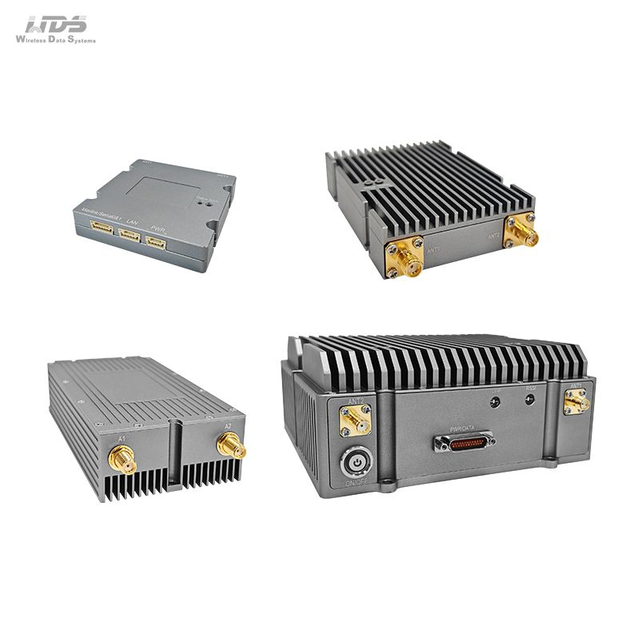
Diagnostics become more useful when a portable Wireless Mesh Radio combines link-quality data with topology, traffic, node relationships, and spectrum information. WDS MIMOmesh systems include network-topology records, link field strength and SNR monitoring, upload and download traffic statistics, node-distance information, spectrum scanning, and configurable RF parameters. These measurements do not automatically identify every hidden node, but they give operators several data points for testing whether a collision pattern matches the topology.
This distinction matters because simply improving an RSSI number may leave the actual contention relationship unchanged.
Rule out the three problems most often confused with hidden nodes
Suspected problem
Useful distinguishing sign
Hidden nodes
Performance falls mainly when mutually hidden transmitters compete for the same receiver
Weak RF link
Poor performance continues when the link is tested alone and usually corresponds with weak link quality
External interference
Loss or channel congestion can remain even when a second mesh transmitter is inactive
Route instability
Next hops or end-to-end paths change independently of the collision pattern
A controlled test is more reliable than guessing from symptoms. Start with one transmitter, record retries, latency, and throughput, then add the suspected competing node while keeping the traffic pattern comparable. If performance changes significantly, alter only one variable at a time—position, transmit power, channel, bandwidth, or relay choice—to narrow down the cause.
Fix Hidden-Node Collisions Without Creating a New RF Problem
Start with node and relay geometry
Physical layout should be checked before protocol settings are changed. Moving a relay, adjusting antenna orientation, avoiding an obstruction, or choosing a different forwarding position can improve mutual visibility between nodes that previously could not sense one another. In outdoor deployments, terrain and structures may matter as much as distance; in mobile networks, the relevant geometry includes where the radios will move, not just where they were installed.
Large coverage areas are not automatically better. Extending one relay's reach may allow more nodes to communicate with it while also increasing the number of transmitters that cannot hear each other. A Wireless Mesh Radio design should therefore balance coverage with manageable contention domains rather than treating maximum reach as the only objective.
Use transmit power to correct visibility, not maximize range
Transmit power can help when a modest adjustment allows two hidden transmitters to detect each other before accessing the channel. That does not mean every radio should run at maximum output. Higher power can enlarge interference footprints, create unbalanced links, and cause more distant nodes to compete for the same airtime.
Power should be considered together with antenna configuration, receiver sensitivity, relay placement, and expected path loss. A rugged outdoor Wireless Mesh Radio can combine transmission power control with multi-hop routing and configurable RF operation, allowing power to be tuned as part of the wider network design. Power is therefore better treated as one part of network tuning rather than a stand-alone solution.
Use RTS/CTS when avoided retransmissions justify the overhead
RTS/CTS addresses hidden-node contention by reserving airtime before the larger data transmission begins. A transmitter first sends a Request to Send. The receiver answers with Clear to Send, and nodes that hear that CTS defer access for the specified period before the reserved transmitter sends its data.
This helps because two hidden transmitters may be unable to hear each other while both remain capable of hearing the common receiver. Under a controlled hidden-node workload, enabling RTS/CTS can substantially reduce expensive data-frame collisions and improve the number of successfully received packets. RTS frames can still collide, however, and the control exchange consumes airtime of its own.
RTS/CTS is therefore most useful when the airtime saved by preventing expensive data-frame collisions is greater than the overhead of the handshake. It should be tested against the actual traffic pattern rather than enabled simply because a mesh contains many radios.
Tune channel and bandwidth after identifying the collision pattern
Changing channels does not automatically eliminate a geometric hidden-node relationship. If two nodes cannot sense one another, moving both to another frequency may preserve the same basic condition. Channel and bandwidth settings still matter because they determine what other traffic and interference share the operating spectrum.
Spectrum scanning can help identify heavily occupied channels, while narrower bandwidth or another operating band may reduce competing energy in difficult RF environments. Frequency agility can also help when external interference changes over time. WDS MIMOmesh radios support configurable channel widths, spectrum-aware channel selection, adaptive frequency hopping, multi-band operation, beamforming, spatial diversity, and spatial multiplexing.
Those tools are best treated as part of wider RF optimization. They can improve operating conditions, but they should not be described as a substitute for fixing poor relay geometry or hidden carrier-sensing relationships.
Keep Hidden Nodes from Returning as the Mesh Changes
Test the network as a system, not as separate radio links
Commissioning should include simultaneous traffic through important relays rather than a sequence of isolated point-to-point tests. A network that performs well when every link is tested individually may behave very differently when several branches compete for the same forwarding node. Realistic uplink, downlink, and multi-hop traffic exposes contention that an idle mesh will never reveal.
Relays that aggregate several flows deserve particular attention. Monitor their retry behavior, usable throughput, and latency while multiple neighboring nodes transmit. A practical diagnostic path is: good link quality but poor performance → test concurrent traffic → identify whether the same relay is involved → check whether competing transmitters can sense one another → choose the appropriate topology, power, RTS/CTS, or spectrum adjustment.
This system-level approach is especially useful in a Wireless Mesh Radio deployment because every additional forwarding relationship can change who competes for the shared medium.
Recheck after movement, route changes, or RF-environment changes
Hidden-node conditions are not necessarily permanent. A mobile node can move behind an obstruction, a route can reorganize around another relay, or a new vehicle or structure can change propagation enough to create a carrier-sensing blind spot. The network may remain connected throughout these changes, which makes the resulting performance problem easy to misinterpret.
Mobile and outdoor deployments should therefore correlate retransmission or latency spikes with topology and position changes. WDS MIMOmesh systems support distributed, centerless operation, dynamic Layer 2 or Layer 3 routing, multi-hop relay modes, topology monitoring, and GNSS-related management options, providing useful context when RF relationships are changing.
The objective is not to make every radio hear every other radio. A well-designed mesh only needs to prevent mutually hidden transmitters from repeatedly competing at critical receivers without an effective coordination mechanism.
Conclusion
Hidden-node problems are easiest to solve when network teams look beyond signal strength and examine how multiple transmitters compete for the same relay. Testing concurrent traffic, adjusting node placement and transmit power, and using RTS/CTS or channel changes selectively can improve stability without creating unnecessary RF complexity.
For deployments that need flexible multi-hop connectivity, Shenzhen Sinosun Technology Co., Ltd. provides Wireless Mesh Radio solutions that can support practical network planning and RF management. Used alongside careful testing and topology design, these systems can help maintain more consistent communication as traffic, routes, and operating conditions change.
FAQ
Q: What causes the hidden node problem in a wireless network?
A: It occurs when two transmitters can reach the same receiver but cannot detect each other, causing simultaneous transmissions, packet collisions, retransmissions, and reduced network performance.
Q: How do hidden nodes affect wireless mesh network performance?
A: Hidden nodes waste shared airtime through collisions and retries. In multi-hop mesh networks, one affected relay can also increase latency and reduce throughput across several forwarding paths.
Q: Can RTS/CTS completely solve the hidden node problem?
A: RTS/CTS can reduce collisions by reserving airtime before data transmission, but it adds protocol overhead and may not eliminate every hidden-node condition in complex multi-hop environments.
Q: How can hidden nodes be detected in a Wireless Mesh Radio network?
A: Compare performance under single-node and simultaneous traffic. Rising retries, latency, or throughput loss despite stable RSSI and SNR can indicate transmitters competing without sensing each other.
Q: What is the difference between hidden and exposed nodes?
A: Hidden nodes transmit simultaneously because they cannot detect each other. Exposed nodes unnecessarily delay transmission because they detect nearby activity that would not actually interfere with their receiver.
Q: Does increasing transmit power fix hidden nodes?
A: Sometimes, if higher power allows previously hidden transmitters to detect each other. However, excessive power can enlarge contention areas, increase interference, and create asymmetric radio relationships.