Radio links often look reliable during installation, then begin dropping packets when machinery starts, vehicles move through the site, or new transmitters occupy the band. The real question is not simply which radio sounds more advanced, but how each design behaves when interference appears.
In an FHSS vs fixed frequency comparison, frequency hopping usually has an advantage against narrowband or intermittent disruption, while a fixed channel can remain efficient in controlled spectrum. Understanding where each approach fails, how latency and retries change, and which RF conditions matter most helps engineers choose a link that will stay dependable after deployment.
The Interference Patterns That Separate FHSS from Fixed Frequency
When One Channel Is Continuously Occupied
Persistent narrowband interference creates the clearest difference between the two radio types. A fixed-frequency link remains exposed for as long as the interfering transmitter occupies its selected channel. Packet errors continue, retransmissions accumulate, and the connection may remain unavailable until the interferer stops or the system is manually retuned.
An FHSS radio meets the affected frequency only when its hop sequence passes through that channel. A packet sent during that hop may still be corrupted, but the next transmission can occur elsewhere in the band. Rapid, synchronized movement between channels and short dwell times limit how long interference on one frequency can affect the link.
This advantage is especially relevant when a narrowband telemetry transmitter, industrial control device, or other emitter occupies only a small portion of the available spectrum. FHSS does not remove the interferer; it reduces the link’s dependence on the blocked frequency.
Intermittent Noise and Short Co-Channel Collisions
Brief interference bursts produce a similar contrast. When a burst lands directly on a fixed channel, all traffic using that channel is exposed for the duration of the event. Depending on the application, even a short interruption may delay a control command, create missing telemetry records, or trigger repeated connection attempts.
A hopping link is more likely to distribute the impact across several packets. Retransmission can recover lost information after the radios move to a cleaner frequency, although the recovery process adds latency and reduces effective throughput. Two FHSS networks can also occupy the same channel at the same moment, but the collision may end as their sequences continue along different paths.
Implementation quality remains important. A broad hop set, suitable timing, and effective recovery behavior can limit disruption, while poorly designed hopping may simply move through congested channels repeatedly.
When Hopping No Longer Provides a Clear Advantage
FHSS becomes less effective when interference occupies most of the hopping band rather than one or two frequencies. A raised noise floor across the complete hop set leaves few clean channels to visit. Likewise, a powerful transmitter close to the receiving antenna may desensitize or overload the receiver front end, affecting reception even when the desired signal hops elsewhere.
When two frequency-hopping devices operate in the same band, interference can increase message delays, reduce transmission success, and eventually cause complete link failure. Retransmission may prevent an immediate hard failure, but it can also produce long and highly variable delays as interference becomes stronger.
Interference condition
FHSS response
Fixed-frequency response
Likely result
One continuously occupied channel
Losses occur when the sequence visits it
Link remains continuously exposed
FHSS advantage
Short interference bursts
Several hops or packets may be affected
All traffic is affected during the burst
Usually FHSS
Several congested channels
More retries and lower throughput
Depends on the selected channel
Deployment-specific
Wideband or overload-level interference
Most hops are affected
Active channel is affected
Neither clearly wins
Clean, coordinated spectrum
Hopping offers limited added value
Simple, stable operation
Fixed frequency may suffice
What Link Failure Looks Like in Practice
Fixed-Frequency Links Tend to Fail Continuously
Interference on a fixed-frequency link usually creates a straightforward degradation pattern. Packet error rates rise first, followed by more retransmissions, lower throughput, and longer response times. If the interfering signal remains sufficiently strong at the receiver, the connection can become unusable and stay that way.
Recovery normally requires a change in conditions. The interferer must stop, the radio must move to another channel, or the installation must be improved through better antenna placement, increased separation, or more selective filtering. Until one of those changes occurs, every new packet faces the same blocked channel.
This behavior has one operational benefit: diagnosis is relatively direct. A technician can observe the active frequency with a spectrum analyzer and compare interference levels against link performance. The risk is that a channel that appeared clear during installation may later be occupied by newly deployed equipment.
FHSS Links Usually Degrade Through Losses and Delay
An FHSS link often fails less abruptly. At first, packets sent on poor channels are lost while traffic on cleaner hops continues. Retries then convert RF disruption into variable latency, reduced application throughput, and inconsistent response times.
Users may notice delayed commands or irregular telemetry before they see a complete disconnection. Under more severe conditions, the radios can require additional time to resynchronize, particularly when too many consecutive hops are unusable. Frequency-hopping retransmission can delay hard failure, yet interference below the failure threshold may still create unpredictable message delays.
For monitoring traffic, an occasional recovered packet may be acceptable. A time-sensitive control system, however, may treat a highly variable delay as seriously as a dropped connection.
The Engineering Details That Can Change the Outcome
Interference Power, Bandwidth, and Proximity
The FHSS or fixed-frequency label alone cannot predict field performance. The interfering signal’s bandwidth must first be compared with the width of the fixed channel, each hopping channel, and the entire FHSS operating band. Interference occupying 200 kHz may devastate one narrow channel while affecting only a small part of a wide hop set; a signal spanning the whole band changes that result.
Power at the receiver matters just as much as occupied bandwidth. A low-power interferer may have little effect when the desired signal has adequate margin, whereas a nearby high-power transmitter can create a near-far problem. Receiver desensitization or front-end overload may then occur even when the two signals are not perfectly aligned in frequency.
Physical installation can materially change the outcome. Greater antenna separation, suitable polarization, directional antennas, filtering, and shielding may improve coexistence without changing the radio protocol. Interference severity also changes with transmitter power and the physical distance between devices and antennas.
Hop-Set Design, Timing, and Recovery Behavior
Not all FHSS implementations provide the same resilience. Performance depends on the number of hopping channels, how widely they are distributed, the time spent on each channel, and whether the system can stop visiting persistently poor frequencies. A larger, well-distributed hop set generally spreads risk more effectively than a small set concentrated in one congested portion of the band.
Dwell time and hop rate shape the trade-off between exposure and efficiency. Shorter dwell periods limit the time spent on a blocked frequency, but rapid hopping introduces coordination overhead and leaves less time for useful payload. Retransmission can recover missing packets, although repeated retries consume airtime and may make latency increasingly unpredictable.
Synchronization is equally important because the receiver must follow the transmitter’s sequence at the correct time. A temporary interference event can become a longer outage when the radios cannot resynchronize efficiently. Frequency hopping may also complicate interception or targeted jamming, but that property should not be confused with encryption. The hopping sequence changes the carrier frequency according to a shared algorithm, while encryption protects the transmitted data itself.
Link Budget and Receiver Quality Still Set the Baseline
Both architectures remain governed by the same RF fundamentals. Transmit power, receiver sensitivity, antenna gain, cable loss, path distance, obstructions, and fade margin determine whether the desired signal arrives with enough strength to be decoded. Receiver selectivity and adjacent-channel rejection determine how well the system separates useful traffic from nearby emissions.
FHSS cannot repair an inadequate path. A badly positioned antenna, damaged cable, obstructed line of sight, or insufficient margin will continue to cause failures across the hop set. Moving between frequencies may even reveal frequency-selective fading when some channels propagate less effectively than others.
Data rate also influences robustness. Depending on the radio design, a lower air-link rate may provide greater system gain or improved receiver sensitivity, while a higher rate may require a stronger received signal. The comparison must therefore involve complete radio configurations, not simply an FHSS checkbox against a fixed-channel checkbox.
Choosing the Radio That Fits the Deployment
Where FHSS Earns Its Extra Complexity
FHSS is usually the stronger candidate when the spectrum changes throughout the day and nearby transmitters cannot be centrally coordinated. It suits installations where manual channel changes would be difficult, where license-free bands contain multiple independent users, or where a brief recovered packet loss is preferable to a prolonged channel outage. Moderate-rate telemetry, control, Ethernet, and serial traffic often align well with that operating model.
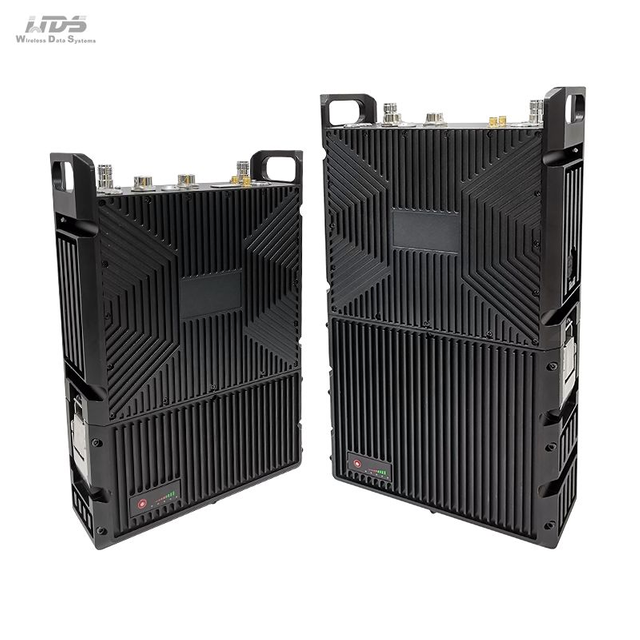
The WDS iNET300/iNET900 uses DTS/FHSS technology for industrial wireless IP and Ethernet connectivity. Available configurations support Ethernet bridging and serial-gateway functions for fixed infrastructure such as wells, pipelines, storage tanks, and utility meters, as well as vehicle-based operations.
Such assets may remain deployed for years while the surrounding RF environment changes. Ethernet bridging and serial migration also allow a long-range industrial FHSS network to carry operational data without requiring every legacy field device to become a native wireless endpoint. The choice still requires site testing because no radio configuration guarantees resilience under every spectrum condition.
Where a Fixed Channel Is the More Sensible Choice
Fixed-frequency radio deserves serious consideration when a clean channel can be coordinated and maintained. A stable RF environment reduces the value of hopping, while continuous channel use can simplify configuration, monitoring, and troubleshooting. Predictable latency may also be easier to achieve when the link does not need to hop, resynchronize, or recover packets lost on individual frequencies.
A fixed channel can be the better option when:
●Spectrum ownership or coordination keeps other transmitters away from the operating frequency.
●The site is routinely monitored and the radio can be retuned when conditions change.
●The available band is too congested to create a useful hop set.
●Straightforward fault isolation matters more than protection against unpredictable channel occupancy.
●The application requires stable timing and has little tolerance for variable retransmission delays.
The selection process should begin with the interference footprint. Determine whether disruption is localized or band-wide, establish whether the channel can be controlled, and define acceptable outage duration, latency, and throughput. FHSS fits changing and uncoordinated spectrum; fixed frequency fits a stable, managed channel.
Test the Decision Before Installation
Recreate the Real RF Environment
Begin with a spectrum survey at the actual installation site rather than relying on a clean bench test. Measurements should cover different shifts, operating periods, and equipment states so that persistent carriers, periodic bursts, occupancy changes, and nearby high-power transmitters are captured. A single short scan can miss the source that causes failures only when particular machinery or mobile equipment is active.
Reproduce realistic antenna height, orientation, cable loss, path distance, obstructions, and device density during comparison testing. Both radio types should face a single-channel interferer, interference across several hopping channels, wideband noise, and multiple power levels. A practical test process begins by collecting representative field parameters, recreating those conditions in a controlled environment, and comparing laboratory performance with field behavior.
Judge Application Performance, Not Only Signal Strength
Received signal strength is useful, but it cannot describe the complete user experience. Record packet-delivery rate, longest interruption, average and worst-case latency, retry rate, effective throughput, and recovery time after interference. Testing should use realistic packet sizes, reporting intervals, and application protocols.
Pass/fail thresholds need to be defined before the trial. Otherwise, a link that “usually works” may be accepted despite delays that violate the control system’s operational requirements. Retransmissions can preserve communication while masking substantial and highly variable delays, which is why application-level measurements are necessary.
Select FHSS when it consistently converts unacceptable sustained outages into short losses the application can tolerate. Select fixed frequency when a managed channel meets delivery and timing targets without adding hopping overhead or recovery complexity.
Conclusion
The FHSS vs fixed frequency decision ultimately depends on the interference environment. FHSS generally handles narrowband and intermittent disruption more effectively, while a fixed channel can remain practical where spectrum is clean, controlled, and easy to monitor. Link budget, receiver quality, latency requirements, and field testing should still guide the final choice.
Shenzhen Sinosun Technology Co., Ltd. offers industrial frequency-hopping radios and wireless data solutions for applications requiring resilient Ethernet, serial, or telemetry links. Matching these capabilities to real RF conditions can reduce prolonged outages, simplify remote connectivity, and improve operational reliability without adding unnecessary complexity.
FAQ
Q: What is the main difference between FHSS and fixed-frequency radio?
A: Fixed-frequency radios stay on one selected channel, while FHSS radios switch among multiple channels using a synchronized sequence shared by the transmitter and receiver.
Q: In an FHSS vs fixed frequency comparison, which handles interference better?
A: FHSS usually handles narrowband and intermittent interference better because it leaves affected channels quickly. Fixed frequency can perform equally well when its operating channel remains clean and controlled.
Q: Can FHSS eliminate all radio interference?
A: No. Wideband interference, receiver overload, poor antenna placement, or insufficient link margin can disrupt an FHSS link across most or all hopping channels.
Q: Does frequency hopping increase radio range?
A: FHSS mainly improves reliability rather than guaranteed range. Actual coverage still depends on transmit power, receiver sensitivity, antennas, terrain, obstructions, and the required data rate.
Q: When is fixed-frequency radio the better option?
A: Fixed frequency is practical when a clear channel can be reserved, spectrum conditions are stable, predictable latency matters, and technicians can monitor or retune the link.
Q: What should be tested before choosing either radio type?
A: Compare interference bandwidth and strength, channel occupancy, hop-set design, receiver quality, link budget, latency tolerance, throughput needs, and recovery time under realistic operating conditions.